Fantastic Stories Site Live

fs-219-225w-sidebar
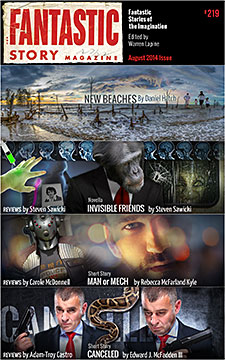
The first webzine issue of Fantastic Stories, the ebook edition, available exclusively at the Fantastic Stories website.

I’ve taken a short break from writing to work on a website for long-time friend and publisher Warren Lapine, a webzine version of Fantastic Stories. The last magazine I worked on was Realms of Fantasy, which was also published by Mr. Lapine. Both experiences have been fascinating, being on the other side of the publishing process, working with writers and editors to get their stuff out and into the world. I’ve worked about half my life as a designer; graphic designer, interface designer, illustrator, animator or photographer. I’ve frequently morphed ‘design’ into various forms of original content creation, even when the budget wasn’t there for that, enjoying the creative side and maximizing the time spent there. So this cover is mine, repurposed out of the site illustrations. The New Beaches illo is the best, a photo montage of three images that barely looks like a montage; I’ve combined a weird super-cell storm with a flooded beach and some people running. Check the site out, and if the stories intrigue you, buy the magazine for $1.99. The texts are free online for a month, but novellas are tough to read on screen, so seriously, just spend the two bucks. It’s why we have the ebook edition; read the short stories and the reviews online. I’ll be selling my own reprint anthologies of short stories at Fantastic, at a higher margin than any other online marketplace; I’ll announce that in a few days and if people have been considering buying my stuff, and have had a hard time finding Asimov’s on the stands, you can pick up my stuff from the Fantastic / Wilder book store at the site. I’ll be putting a week a month into the magazine but hope to get my writing back on track and start meeting my word counts in and around that.

Sensawunda! Of All Possible Worlds Reviewed…

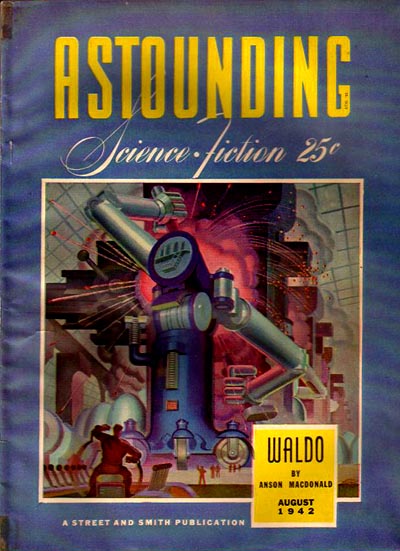
A key to one of the many offhand comments made in my novella "Of All Possible Worlds." Costas says, "I think we found Waldo."
A key to one of the many offhand comments made in my novella “Of All Possible Worlds.” Costas says, “I think we found Waldo.”

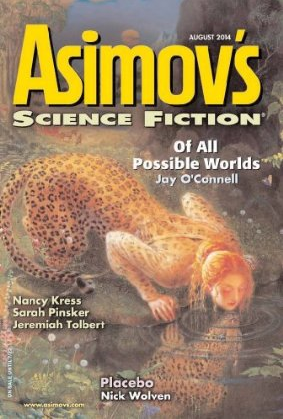
After qualifying her comments by saying that ‘none of the stories enthused her greatly,’ Lois Tilton at Locus goes on to say many nice things about my cover story novella in the August 2o14 issue of Asimovs.

This one is a nostalgic fannish delight, revisiting the sensawunda of the goldenAstounding age with Orgone boxes, Dean Drives, and John W Campbell, a personal friend/rival of Galen’s. The plot is a full-stuffed sausage, bursting its casing with skiffy references, alternate timelines, aliens, and red-herring gizmos.

The Tangent review by Clancy Weeks was also gratifying:

 “Of All Possible Worlds,” covers a lot of ground, selecting ingredients from several genres and mixing them in a perfect recipe of alternate worlds. Several times I was sure of the eventual outcome, only to find myself at square one again with no clue as to the possible resolution. To me, that’s the sign of a ripping good yarn.

The story consumed me for months; Sheila Williams at Asimov’s suggested the ending wasn’t quite right, confirming the verdict of all three of my writing workshops so I took another crack at it and the end result was, I think, better.

I will be releasing an expanded edition as an ebook with both endings in a few months, I think; the original ending, about a short stories worth of content, has a lot of stuff in it, and there’s an extra scene that I have wanted to write for awhile now.

I’ve gotten three or four nice notes on this blog about the story as well.

If you read and liked the piece, please feel free to head over to Goodreads and give it a rating and a short review. Anything to displace the one line written by the one guy there with the super grumpy looking avatar.

The No Pants Dream

One of the things I’m doing in this blog is talking about what it feels like to go from a person making an occasional sale to a semi pro or small press market to selling stories to bigger, national magazines. The August 2014 issue is the first time my name has appeared on the cover of Asimov’s; it’s my forth story published, and the longest piece of my career, a short novella.

I’ve been hugely gratified to have three or four people tell me how much they liked the story on this site. Strangers, from hundreds of miles away. I can’t really tell you what that means to me, other than to say, it’s good.

When you first start writing you imagine readers and accolades and awards, if not tomorrow then some day. As life has it’s way with you, and you settle in for the long haul, you get over that. Writing becomes some part of you, a ritual, meaningful, part of the way you deal with the world, but, often for years, the only people who read what you write are a handful of work shoppers, friends and beta-readers. You forget, almost, that you intended for your work to be read by many.

Then, in some way, it happens, and thousands or tens of thousands or hundreds of thousands or millions of people read your words.

So I’m at tens of thousands now, optimistically.

But it hits you, that you’re out there. You’re putting yourself out there. Sure, it’s fiction. Sure, those characters aren’t you.

But really they’re all you.

The world is you, the characters are you the craft is you the plot is you. Your pessimism or optimism your quirks, your fetishes, your blindspots, your weirdnesses. You’ve cracked open your skull and invited tens of thousands of strangers to wriggle around through thick glistening folds of your cerebral cortex.

Sorry about the thick glistening folds there.

There’s a flash of horror, there. Sure you’ve been trying to do this for decades. Yes, you have succeeded, more so now than ever. But if, like me, you got there by diving deep, mining any and everything you can from a lifetime of peculiar struggle, from a closet packed deep with demons, there’s this ‘oh shit,’ moment, too.

Suddenly you get why people use pen names.

You know that dream, where you suddenly realize you’re not wearing any pants? But you’re out in public? And even though nobody has noticed up to that point in the dream, you know, now that you know, that other people are gonna start noticing. Any second. Are you even wearing underwear?

You’re too scared to check.

So some new muscle needs to get stronger. (This is new metaphor, honestly, stop thinking of me pantless. My eyes are up here.)

The same muscle you first flexed with the first story you shared that scared you spitless; you shared it with a work shopper or beta reader or your friend, and you could see their face and they could see yours and you talked about it.

Your heart hammered in your chest like it was going to burst.

There is nothing like looking someone in the face as they struggle to be honest and supportive about your work–at the same time. Watching them fail, by lying, or by reducing everything you’ve done to ashes, is I think where many of us learn how to write.

(Sending stuff to magazines and editors is different, very easy at first, because you can’t rally visualize them very well and the rejection slips are so terse you often don’t get the feeling anyone is paying attention. Online workshops, ditto. )

Anyway, you’re out there, and people are reading you and they  have opinions. They write reviews. I’ll talk about that next, but to some degree it’s an entirely different thing, than the workshop, because, regardless of what anyone says about your work, it’s been published. It’s out there. You did it. You got paid. Someone believed in you enough to buy you.

Will you get used to walking around pantless?

Only time will tell.


Maybe. If he lost the glasses.

So it’s 2 am and I’m not sleeping so I wanted to share something that has been going through my head since my younger son got his contact lenses last week, a little story I told him, which I now tell you.

I was in college, in a between relationships epoch; I’d finally broken up with my on-again, off-again, high-school girlfriend, Ellen, or she’d broken up with me, or her boyfriend had vowed to kill us all if we got back together, or something. (OK, it was the boyfriend killing us.)

I remember thinking, “Well, we can’t let that stop us, right?” (her breaking up with him, and going out with me, again.)

Her response. “I’ve seen his gun. Yeah. We’re not happening.”

So, this story isn’t about that, but funny, yeah?

No, this story is about a time afterwards, as I meandered my way towards the completion of my seven year BFA degree in Selected Studies, when I was, in the parlance of the day, high and dry. I know, ick. But we said such things, and my friend Ed Reynolds told me about a girl who worked the reception desk at the hotel he was a security guard for, and how he thought I should meet her.

I was interested. I guess that goes without saying. But, I said, I need to get some contact lenses. I’d stopped wearing them, after five years or so, for various reasons (My eyes didn’t’ like them) but I knew I could wear them for a few hours at a time, and I wanted to make a good impression. You see, I had two personalities, back in high-school, pre and post contact lenses, and the post lens personality got the girlfriend.

We have to talk about my eyes for this story to make sense. I have bad eyes. Very thick glasses. My childhood was replete with bigger guys grabbing my glasses off my face, putting them on and saying things like, “HOLY SHIT YOU MUST BE FUCKING BLIND.” Before the invention of high-index plastics, the lenses of my glasses resembled the bottom of coke bottles.

Hence, my middle school nickname, coke bottles. Thanks Ricky Ferraro. May you burn in hell. Oh and the optics gave me beady eyes.

My friend Ed looked at me in shocked disbelief. “Dude,” he would have said, if we said dude, but let’s go with that, “I can’t believe this. We’re adults. You think I’m going to hook you up with someone so shallow as to rejected you instantly, out of hand, because you wear glasses?” He smiled and laughed and I agreed. Yeah. I’m a self conscious dick.

We figured out a scheme, to save myself any possible embarrassment, where I would come by the desk and ask to see him, and I could see the girl, and she could see me, and then he could ask her, well, would she go out with me? Yeah, we were grown ups.

What does it say about me that I am telling this story with no clear memory of what she looked like? I see a pretty girl with long blonde hair in my mind. That may be Marsha Brady, now that I think about it. Was she skinny? I don’t know. All I know is, I was interested enough to ask Ed, afterwards, “so, Dude,” if we said that, “what did she say?”

Ed cracked up. Couldn’t make eye contact. “Oh. No. It’s not important, but no, she doesn’t want to go out with you.” He laughed some more.

“Tell me what she said, Ed. Exactly.”

“Maybe if he lost the glasses…”

What can I say? It hurts to be right? That we know how others see us, really, deep down in our guts? What does this have to do with writing, you ask?  Maybe it’s that we know our weaknesses. And as much as we would love to think that people will just overlook them–they don’t. Ever. So if you know there is something bad, about your prose, fix it. You’re not fooling anyone.

Marsha Brady will not be amused.


Free Flash Fiction: Any Day Now

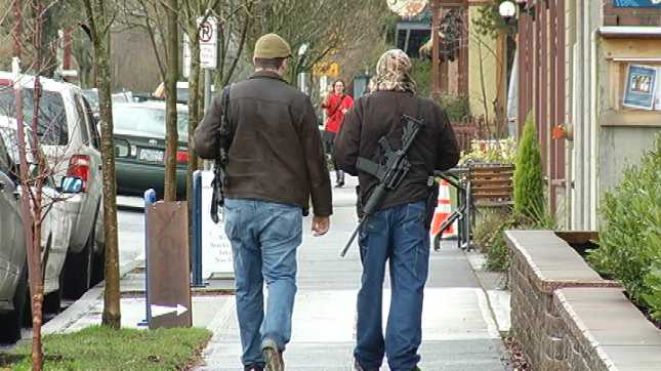
AR15-in-PortlandA clean cut man in a powder blue shirt and khaki trousers with an assault rifle hanging from a shoulder strap strolls through a Texas park at dusk, on his way home from an open carry event at the local Dip n’ Dunk coffee shop. Dip n’ Dunk has not banned long weapons from its local chain of stores, so his group meets there, even though the coffee is terrible.

The Clean Man misses the Starbucks days.

Across the baseball field, where a group of middle schoolers are playing softball, he spots another man carrying a long gun emerging from a tangle of shrubbery. This man has long scraggly hair, and is wearing a ripped t-shirt which has, scrawled in something reddish brown, the phrase GOD HATES YOU. Several drywall screws appear to be protruding from his skull on the left hand side, each trickling blood into his filthy mat of tangled hair.

The Clean Man approaches the filthy one.

“Hi,” he says.

The Filthy Man grunts.

“I don’t remember you from the meetings.”

“What meetings?”

“The open carry meetings.”

“I don’t go to meetings,” the man says. His hands tighten around the weapon, his finger curled around the trigger.

“Oh!” says the clean cut man. “So, may I ask, why are you out here with a gun?”

The man reaches up, turns one of the screws in his head, winces, and says, “Why are YOU out here with a gun?”

“I’m exercising my second amendment rights,” the Clean Man says. Sweat has broken out under his armpits, staining his shirt a darker blue.

“Me too,” says the Filthy Man. “Heh.”

“Why do you have screws in your head?” the Clean Man asks.

The filthy man winces, and reaches up, touching the screws, one by one.

“I don’t know what you’re talking about,” the Filthy Man says.

The Clean Man glances over, and sees the children standing, paralyzed in the playing field. Somewhere, in the stands, a baby cries. The Filthy Man bares a mouthful of stained and broken teeth.

“I think maybe you’re making them nervous,” the Clean Man says.

“I think maybe you’re making them nervous,” mimics the filthy man in a high pitched falsetto.

“I’m serious,” says the clean man.

“I’m serious,” mimics the Filthy Man.

The clean man glances back at the children, making a ‘run away now’ gesture with his free hand. When he looks back, the filthy man has his assault weapon leveled at his chest. The clean man tightens his grip on his gun, almost raises it, but stops, as the Filthy Man shakes his head.

“I feel threatened,” says the Filthy Man.

“I’m not being threatening!” shouts the Clean Man, furious that he has let the bad guy get the drop on the good guy. The gun in his hand is trembling.

The Filthy Man  winces. “Why are you shouting?” he says. “Are you crazy?”

The Clean Man looks around. Has anyone called the police? The children are still standing in the field, staring at the two of them. The parents in the stands are looking at them, motionless. He tries to make eye contact, to signal, that someone needs to call the police.

But nobody calls the police, because everyone is used to people walking around with assault rifles. They’re everywhere now.

“This is not how this is supposed to happen!” the Clean Man says. A spreading blot of urine has bloomed on the front of his khaki trousers. One of the children in the field points and laughs.

The filthy man reaches up and twists one of the screws in his head, his finger on the trigger the whole time.

Then he smiles from ear to ear.

Doc Savage Lives Again in William Preston’s Old Man Cycle

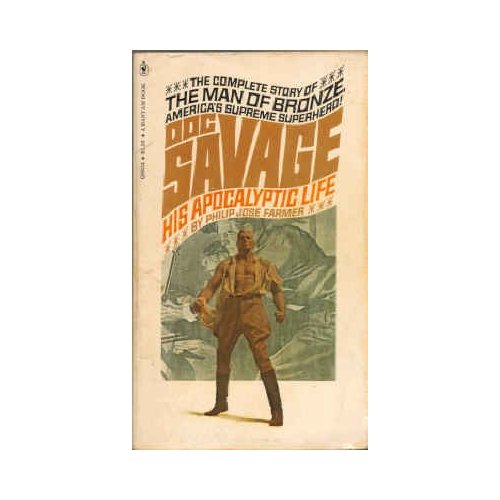
41Oj4ouwboL._SS500_As it turns out, Doc never really died.

Oh, the Old Man of William Preston’s cycle of Asimov’s novella isn’t exactly Doc Savage, but rather an update on the original pulp superman. Doc, the pulp hero of the 30s and 40s, was in no sense a supernatural being, an alien, nor was he the product of experimentation or exposure to radiation, he was just… realized. Perfected. Self-actualized. A polymath genius and a perfect physical specimen. His coppery skin earned him the name, the man of bronze, rescueing him from unpleasant comparisons to Aryan supermen. (the Doc is a miracle of multiculturalism compared to, say, E.E. Smith’s Lensmen, the original Green Lanterns, who are are super-white.)

Preston intersects the Doc Savage myth with mythic elements of the post millennium; 911, camp x-ray, and explores some of the craziest aspects of Savage; namely his ability to heal certain kinds of criminals through psychosurgery.

His novellas, Helping Them Take the Old Man Down, Clockworks, Unearthed, and Each in his Prison, Thinking of a Key, tell pieces of an as of yet unfinished cycle, though each story is more or less self-contained and can be read and enjoyed on its own.

The latest installment, I think, suffers some if one hasn’t read the second story, Unearthed, and the text more or less tells you to read the previous installment first, by having the protagonist unearth a pulp magazine titled The Stone Avenger, which is this Doc’s origin story; this gives you the background needed to fully understand the resolution of the third novella.

If this all sounds meta-texty and post modern, it isn’t, at least, it isn’t what the stories seem to be about. It’s not campy either. All these pieces feel heartbreakingly sincere; Preston’s protagonists are a rarity in modern literature. They’re good people. Not cardboard cut outs, either; they’re people confronted with moral choices in difficult situations who more or less figure out how to do the right thing; if barely, and often at great personal cost.

Now that I type that, I think, huh, isn’t that what literature is really for? (More painfully, I think, why the hell don’t I do more of it?)

The stories evoke a primordial sense of wonder, at least, in people of my cohort. And yet, paradoxically, the prose is modern, lean, tactile, full of showing and not telling; in places these texts demand close attention; but this attention is rewarded, always, and the effort is enjoyable.

They combine action sequences with reflection and interiority, deep character and genre crunchy goodness, forging a delightfully new thing under the sun.

Seriously, just buy these things and read them. They’re cool.


August 2014 Asimov’s Kindle Edition on Sale Now with my Novella…

Screen Shot 2014-05-29 at 1.44.12 PM

So the Kindle edition of the new Asimov’s August Issue is out, but I have yet to receive my contributor’s copies, which generally show up a few days before I see it on the newsstands. So this an advance warning.

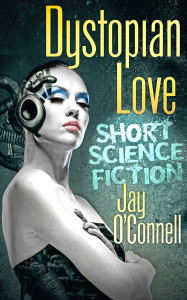
The first person who sees a copy of this issue and emails or facebooks me a photo of the magazine in its newsstand habitat will get an e-copy of my anthology of short stories, Dystopian Love, absolutely free. The second person will get 2 copies. The third, 3, and so on. Eventually, all of Amazon’s cloud will be filled with redundant storage of my book and civilization will crumble. You’re welcome.

Not really! I won’t end the world, promise, not even if you buy and like this issue. Maybe especially not if you like this issue. Also, if everyone could just not tell me what Lois Tilton at Locus says, I’d be really happy about that. I am projecting myself into a parallel universe where her opinion doesn’t make me want to hide under a bridge and do smack.

If people want to subscribe to Asimov’s, to read more stories by me (and others), hey, that would be good. If people want to review this issue on Goodreads… well, I can’t stop you, can I? You might think from this cover design that I have the illustration for this issue, and that the leopard woman has something to do with my story. Well, I can’t say for sure, either way. My title is pretty broad. You’re just going to have to buy the issue, and see, if there’s a leopard woman in my novella. There could be. It is within the real of possibility. If there isn’t, perhaps there will be an excised chapter on this website, with a leopard woman in it. Who knows. Stay tuned.

The Elusive Beauty of the Thing

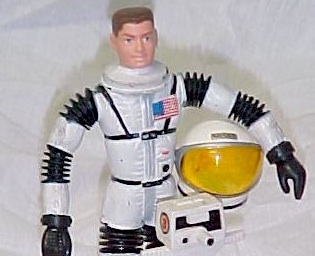
major-matt-masonI have one of those memories of being a kid, one of those curated memories, that you still have because you’ve been taking it out and looking at it, every now and then, your whole life.

I’m five or six or seven years old, living in the Ur-House, the first house, the small four bedroom white clapboard house with the bad wiring, the brass fuses that you screw in like lightbulbs, with the tiny window on the top, so you can see when they burn through.

So I’m living in the Ur-house and I’m playing in the yard, like we used to. Mom is nowhere about, Dad is at his job at the University, and I’m making a thing. I’m using white string and sticks and tiny rocks, and I’m playing on the wall that supports our neighbors driveway, that keeps his yard from spilling into ours.

We lived on a giant hill, a drumlin, like a hobbit hill, cobbled in red brick, to give it traction, and each yard is like a terrace. Which, I suddenly realize, for the first time in fifty years, is why the street is named Scotholm Terrace.

The thing I’m building into a gap in the rubble stone wall is a web. A three dimensional web of string, tied to the stones in the wall, tied to pebbles that I reposition to make the thing look cooler. I’m making it for a long time. Back when time was long. Back when an hour could be an endless abyss, a half-hour an aching hole, if spent at the doctors office, or, a heartbeat, when spent with a friend.

I finish it. Or is it finished? I can’t tell. I can’t remember making anyone else look at it. I don’t know if I needed to have anyone else look at it, then. I’m called away. I forget about the web, the thing.

The next day, there’s a sodden mass of pebbles and dirty string in it’s place. The web has collapsed. I try to remember what was so cool about it. I think about rebuilding. It’s not worth it. I do something else.

My writing is like that web. Caught up in it, the logic of it, I’m at peace. In the clear light of the following day, I’m confused. Why is this worth doing, again? Why am I playing with trash?

There are so many things to do, you see.

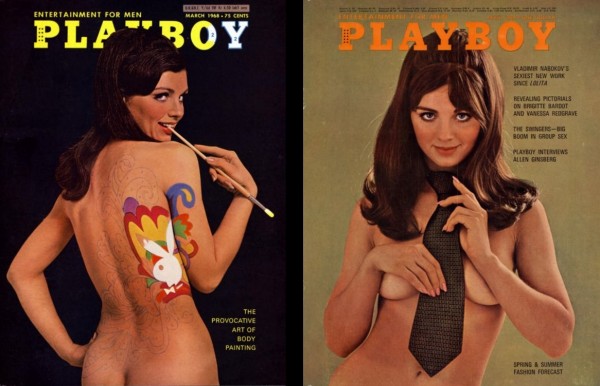
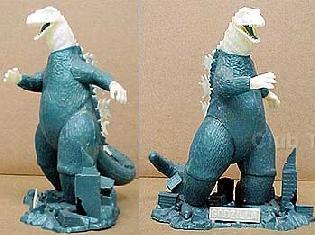
6a00d83451ccbc69e20134876d1ed4970cI have an SST, a drag race car, which I rev up to impossible speeds by pulling a t-shaped strip of plastic through a flywheel gear. I have a model of Godzilla with glow in the dark claws and tiny green plastic army men, and by getting down very low, and shooting up at it with my instamatic, I can make it look huge, forcing the perspective. There are playboy magazines in the house, which I can sneak off with for moments of stark religious wonder. The sixties!

aurglowkitMy mom smokes low tar cigarettes and wears cat glasses and my parents throw loud parties, which get louder as the night wears on, preventing me and my brother from sleeping, and so we sit on the stairs and listen to them, the grown-ups, to the rise of fall of laughter and conversation, smelling cigarettes and booze and the infinite possibilities of the country roiling around us. Viet Nam on the TV, LSD and My Lai massacre and Nixon and Sgt Pepper and the things I make.

The drawings. The secondary worlds. The cutaway underground fortresses, the starships and the giant impossible city sized vehicles.

The paperback cover worlds all around me. Spacescapes and abstracts and lush Frazetta women. Vampirella, Puff n’ stuff and Timothy Leary

Oh! The things that I have seen. The trash that has collected in my mind.

And now, to sit alone in a room and remember life.

What the hell am I doing? Seriously. You tell me.

One of Andy Warhol’s infamous ‘pee paintings.’ Oxidized metal, oxidized by, you know. Pee. You’re welcome.

Sometimes, as I wake up, and the world rushes in, I find myself filled with dread. Dear God. I’m trying to be creative. Again. I’m writing. Again. People are actually seeing the work, and reading it, too (have I mentioned my recent sales yet, again? Hm?). As shaky as this gets me, it’s not as bad as when I find myself thinking of this blog, which is mostly me thinking out loud about my own writing life, my own tiny nothing insignificant writing life, which will not be remembered or celebrated, certainly; why bother talking about it at all? I mean, do it, sure, do your bit, do what you can, make the art you must, but for God’s sake, why talk about it?

You’re not that smart, you’re not that talented. Why in the name of God would anyone want to read your take on things?

It’s a stumper.

So, what am I doing?

I want to celebrate my publications and the editors that have bought me and the publications themselves, but, by itself, that’s just narcissism, so, what else do I bring to this table? More narcissism. Narcissism mayo for the narcissism sandwich of this blog. Bon appetite.

What could I be doing? Well, I could be celebrating the work of my peers, talking about the books I’m reading that are affecting me. Of course, that is revealing, too. My reading is scattershot. The book a day habit of my teens has degenerated to a few books a month, and my criteria, for what I read, is unfathomable even to me. I read a lot of YA, I read stuff that is obviously not even aimed at me; I read things that are soothing, I read things that are reactionary, I read things that are challenging and interesting, too, but not nearly enough. Not nearly enough.

I could be projecting a kind of happy persona, a character based on me, which I would have to, of course, make up, which would be somehow… likable? A persona designed to sell my work, to magazines and eventually as books, because eventually, one suspects I must write books.

So, I could do that. I probably should do that.

Instead I lurch out here and tell some version of the truth of what is going on inside my somewhat ordinary mind.

Seriously. What the fuck.

I have bragged here about word counts, and its time to come clean and admit that, because (insert life-based excuse here) I am barely managing a few hundred words a day, which is fine, if you’re Hemmingway, but I’m not, I’m 50 and I have to get off my lazy ass and get this shit done, toot fucking sweet. (Suite?)

My stuff is selling, in a variety of ways. I should be making more. Even if some of what I make I can’t send out, because, after I cool down and look at it, I see, ok, not good. That’s no reason to stop. No reason to stop. No reason to stop. Right? Right.

Wish me luck.

Advice to Struggling Writers

Here's a Lichtenstein which proves I went to art school and which is tangentially related to my post.
Here’s a Lichtenstein which proves I went to art school and which is tangentially related to my post.

So, in my How Not To Be a Writer series I explored, in depth, the process by which it took me twenty years to make my breakthrough series of sales. I wrote these pieces and this blog to some other version of myself, some younger incarnation, to try to help him or her past the stuff that slowed me down. I also write in the tradition of the wonderful autobiographical sketches by people like Asimov or James Thurber, bits which I often enjoyed as much, or more, than the stories that they surrounded in various anthologies. Not that I deserve such scrutiny. Still, it’s fun.

Who are writers? Where do the come from? Are they like me? What’s it like being a writer? There’s whole rafts of these books out there, it’s a fun sub-genre.

This isn’t that.

For once I’m going to try to be straightforward, to the point.

ADVICE TO YOUNG OR NEW WRITERS BEGINS HERE!

0. Read. Read for pleasure. Also, read higher on the food chain than you want to write and publish. If you want to write like Stephen King, read authors who have more literary fibre than Steven King; because that’s what Steven King does. Read stuff that wins awards and decide if you concur with that judgement. Read reviews and criticism, if only in your genre, but hopefully beyond it as well.

Oh, and read what is being written now, published now, what is winning awards now, what is being talked about now; not exclusively, but this should be a part of what you do, at least, in the beginning. You should read into the past too, but if you’re stuck, in a single era, a single genre, it’s going to be harder for you to get a real sense of what you’re doing.

Because the books you end up writing may not be the book you intended to write. Like it or not, you are a creature of your time and this moment and you cannot help but be informed by it.

1. Write. Write what you want to write. Actually write. Spend actual time writing. If not every day then every week. Measure what you write. Try to write more. Keep trying to write more, until you start spewing utterly useless crap; then write a little less than that. Until the useless crap comes out, though, you don’t know what your capacity really is. Figure this out. When do you dissolve into a shuddering wreck? 2k a day? 5k? 10k?

There’s writing and Being a Writer; being a writer is an identity; writing is an activity. Ideally, these two things line up; in practice, they often don’t. I’ve spoken of Kris Rusche’s Dare to be Bad challenge, of Dean Wesley Smith’s Race Score; if you haven’t read about these things, please do.

In short, don’t let being, or not being a Writer interfere with your writing practice. Write when you feel inspired, and write when you know you’re a fraud. Or perhaps, just edit when you know you’re a fraud.

2. Share what you write with people you have to look at. This can mean classes, face-to-face peer group workshops, graduate programs, internet based workshopping, Here’s a truth. Face to face is better than on-line. Because it’s harder. It’s harder to say sad or hard things to others faces, and it’s hard to hear these things; the whole process hurts much much more, and you can’t shut the pain off by discarding an email or a marked up Word file.

Telling the truth, the whole truth, the hard truth, to another writer is hard because it emboldens them to tell the truth about your writing to you. Learning how to be true without being mean, without being cruel, is difficult. You will screw up and say things you regret. You will be too mean sometimes and too nice other times. But keep trying.

Every workshop, every group of people develops its own internal logic, its own style and tenor; some of these can be damaging and toxic but the rewards, of even a toxic workshop, tend to outweigh the downside.

Honestly, this is a Darwinian environment. The person trashing your story at least read it and showed up to tell you and she thought about it. A lot. To say all those terrible, terrible things.

Professional editors simply do not have the time to do this for you.

They simply don’t. I can say, having had my little breakthrough, that it was form rejects and then acceptances with virtually nothing in between. You can be almost good enough, for years, and you’ll get forms, and then you’ll be good enough, and you’ll get checks. You can be very very close to breaking through and you won’t have a clue, if you don’t have a big, self created honest community giving you feedback.

3. Edit and revise what you write but do not let revisions stop you from writing new stuff. Rewriting doesn’t mean incorporating every suggestion someone gives you. This means hearing critiques and seeing new opportunities in a work; other people will give you permission to add stuff in you wanted to put in; this also means reducing reader confusion; if five, ten people all get the same mistaken impression from your story, the problem isn’t them; it’s your story.

Oh, and sometimes this means cutting, lots and lots of cutting.

There’s a lot of writing that you’ll discover is just you, in character, in deep POV, in the fictive dream, going from place to place in your story; there’s a lot of stuff that you write, that you need to know, that isn’t actually in your story. Other people can help you cut that stuff out.

4. Submit what you have edited. Struggle for publication and readership. I don’t care if you want to be the next Hugh Howy, or the next indypub sensation, still, write finish and submit and search this space. Use a service like Submission Grinder or Duotrope to track your submissions. Follow the rules scrupulously. Stack up rejections. 

Seriously. Stack those things up.

It’s humbling and humiliating and enervating and nauseating. And exhilarating. Because it’s a hard thing to do. It’s hard because nobody can really tell you exactly how to succeed.

You can go to school, and work hard, and go to law school and pass the bar and get a job at a firm and become a lawyer. Making partner of course, is super hard, but the other stuff had rules. Clearly defined rules. On How to Succeed. Tests and courses and content and classes and everything parceled out in bits and bites.

As the rejections pile up, you realize that, in writing, after gaining a modicum of craft and developing a voice, there are no rules, there is no guarantee, you may never make it, all the work might be for naught. and then, you keep doing it some more. And yeah, you console yourself with all the stories of the days of early bitter struggle by the Real Writers you idolize, but honestly, you might not be them. And you know that. You might just suck.

Then you keep doing it anyway.

It will build your character or destroy you; or perhaps just remake you. Because you know what going through something like this is, don’t you? It’s goddamn mythic. It’s heroic. It’s poetic. It will make you into something more than you were before.

I guarantee it.