Before I start, everyone needs to go and read Jame’s Tiptree’s story now free on Lightspeed Magazine, And I Awoke and Found Me Here on the Cold Hill’s Side. It’s a great title, the titles alone of Tiptree’s stories read like short poems, and the stories carry a punch undiminished by the decades that have passed since their writing. There were those who thought Tiptree just might be J.D Salinger writing under a new name. There were those who thought it might be Henry Kissinger.
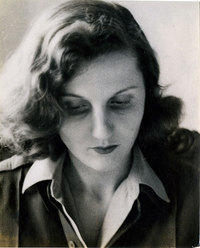
So go and come back. I’m serious. Read the damn thing. It’s short and it’s about sex and it’s written by the person on the sidebar there–intrigued? That person writing as a man. Go!
Ok, James Tiptree, as we now know, is the pen name for Alice Sheldon. Robert Silverberg, an SF great, famously stepped in it with this quote about the mysterious Mr. Tiptree:
“It has been suggested that Tiptree is female, a theory that I find absurd, for there is to me something ineluctably masculine about Tiptree’s writing. I don’t think the novels of Jane Austen could have been written by a man nor the stories of Ernest Hemingway by a woman, and in the same way I believe the author of the James Tiptree stories is male.”
So Silverberg was really really wrong. And since reading that quote, I have resisted pretty much every ‘men are from Mars, women are from Venus’ generalization about male vs female writing as being just as stupid as the comment above.
The undeniable truth of what Silverberg stays speaks not to any intrinsic intellectual quality of male or female, but rather, to the life experiences available to the writers he mentions; Hemmingway can speak of war and manliness and manfulness and Being a Man, and Austin on the importance of marrying the right husband because these are things with which they had a lot of practice.
Alice, born a century and a half or so later than Austin, could write convincingly about more things than Austin, having done them; living in a world in which progress had been made.
All fiction, including Science Fiction, Fantasy and Historical fiction, is about Now, how we understand ourselves, now. The point of prose and the novel being the continually unfolding now mixed with introspection as a cure for solipsism, with every author only ever rendering that single character of him or herself, refracted through imagination to become a secondary creation …
but I’m rambling.
Alice / James often wrote about the other, from the point of view of the other, writing male characters as a man, and nobody noticed her inauthenticity, nobody cared, because she was good at it, and because her name didn’t give her away. Both those things were part of the Tiptree story.
Which brings us to the question of the hour, who should people like me, personally, be writing about? White male heterosexual privileged men? To what standard should we be held?
The upside to being a white heterosexual male writing science fiction, or anything else for that matter, are too numerous to mention, but I’ll take a stab at it. You don’t have to worry that the name you’re used to using will be counted against you (unless your name is gender ambiguous). No one will question the authenticity of your male characters, and your male characters then enjoy a fictive universe where they also enjoy these same privileges–privilege squared! Sticking to People Like Us let’s us get to The Point without a lot of tedious messing around with retrograde stuff which so many of us are sick to death of. Sick to death of!
So many of us have hearts in the right place; we want to live in the mythical meritocracy, where a penis or lack thereof, skin pigment, or lack thereof, sexual preference, or lack thereof, doesn’t determine success.
But we’re not there yet. Pretending that we are is delusional. It may be a useful delusion of course, if it lets you work a little harder, a littler longer, without despair, as the shrunken opportunities for the non-white-male-het doubtless go to those who give it their all; to those that never give up.
And so those of us to-the-manor-born wrestle with who the hell we should be writing about, and how the hell we should be writing about them; we can ignore the whole business, concentrate on the characters we know best, the people just like us, and become another brick in the wall. Or we can try, to write about excluded characters, and be excoriated for getting it wrong.
Because let’s face it, we’re going to get it wrong.
For the simple reason that even if we get it mostly right, the simple act of looking for a flaw can generate them in the eye of the beholder. Inauthenticity drips off of your name alone. Because there are many different ways to be a man or a woman or non-gendered, black or white or interracial, straight or gay or bi, cis or trans or genderqueer, as a member of the in-group we will always be vulnerable to these attacks by the outgroup.
Can you see me playing for myself, the worlds tiniest violin? My thumb and forefinger moving barely perceptible against each other in a see saw motion? I’m not really feeling very sorry for myself. I’m going to do just fine–and I know it in my bones. Privilege!
I just rewrote that sentence three sentences back, by the way. It started out as binary pairings, (man and woman) and I added third states when I realized every couplet was really a triplet, really a continuum. I also included two couplets of thinking about gender, because gender is so damn complicated.
Then I wondered at my ordering in each couple; I put the dominant group first, the other pole second, and the often excluded middle third, representing the order in which each of these states is generally respected, understood or acknowledged. I did all of this without even thinking about what I was doing.
I left my original ordering in, the bad ordering, to reveal that I am in fact, still a person caught up in all of this, unconsciously but now consciously revealing the degree to which I am far from having gotten past all this.
Which sort of reveals the process, and the benefits, of actually trying to do this, actually trying to step outside of yourself and your experience to imagine the other, to role-play the other, to be the other. You’ll get serious insights that can feel meaningful with about five minutes of effort.
There are always those who feel outraged to be saddled with the sins of the father. The fact that most black people are descended from folks who were kidnapped and enslaved and who worked for the first century or two without asset accumulation has nothing to do with the fact that my family can afford to send me to college and theirs can’t. Or if it does doing anything about it will produce more unfairness which in the long run is worse than just considering all slates wiped clean by Lincoln or Johnson or Obama. People who focus, laser-like, on the tiny-subset of instances in which being non-white-het-male has come in handy, with regards to recent policies in government or business or academia.
In my guts, I have no idea why one would focus on these things. This feels like sociopathy. (Of course, I have never personally been burned in this way. So who is the sociopath?)
Seems to me the people being dragged to death behind pickup trucks, those crucified on fenceposts, those shot while asking for help with a broken down car, have more to lose, than the occasional ivy league slot or business promotion. But that’s me.
Which is a very convoluted way of saying I think we should try to step outside ourselves.
Try and fail–for some, and succeed for others. There are women who love Heinlein’s female characters, for example, though I think the majority of double x chromosome types tend to throw late Heinlein books against the wall while throwing up a little in their mouths. (Especially Farnham’s Freehold or Fear No Evil.) But hey, he was a person from a time and a place and he was trying. So RAH is OK in my book. Your mileage may vary.
When we are called out, for trying to write about the other, we should listen, and nod, and say, “I hear you. I’m sorry what I did didn’t work for you. I did my best, but I hope to do better in the future, and maybe get it a little more right. Thanks for reading my stuff. Thanks for telling me how I got it wrong.”
Sure, this is hard, but it beats being dragged to death behind a pickup truck. Right?
At least, in my book.
PS: this is an aspirational piece for me, as my characters tend to represent the tiniest sliver of humanity imaginable. I’m goading myself here to try to do more.