You need time, and a place, and something to write with, and on.
Obviously, as in all things, it helps to be rich, and un-persecuted, and we all know about the stunning percentage of artists and writers who turn out to be dependent upon patronage of one sort or another for much of their careers, but let that go for now.
Write. You don’t need to get a green light from a major studio; you don’t need to license IP; you don’t have to convince angel investors or VC or banks that what you are going to write is worth writing.
There are no auditions, or job interviews.
Entire novels are now being written on smartphones by people crammed into mass transit who can barely wriggle their thumbs.
And yeah, for people under stress, people in debt, people in tough situations, finding the special kind of mental energy and resolve to do this can be elusive, but…
But lets’ face it a lot of people who call themselves writers, a lot of people who want to write, have plenty of time and plenty of space within which to do this and they still don’t.
Why?
I went to Clarion 20 years ago with a man named Eric Nylund, who had the distinction of walking into the workshop with a finished novel already picked up by a major publisher.
As the class got to know each other, in the endless conversation that roils at the fringe of any writing retreat or workshop, the subject of wannabe writers came up, and what Eric would say to someone who asked:
“I want to write more, but I don’t have the time.”
Eric would ask, “Do you have a television?”
They would say, “Yes.”
“Throw it out the window. There’s your time. You’re welcome.”
Fast forward twenty years and television no longer feels like the major culprit. Social media, web-based video and commentary and imagery, is the muffin of distraction, and TV is like hunks of chocolate or nuts or crack cocaine sprinkled through that matrix.
And here I am. Not writing, really, but writing about writing, for ten people, now; maybe a hundred people, eventually. Or maybe a million, if I were to, oh, I don’t know, get off this thing and write something wonderful.
What are the chances of that? Zero, if I don’t get off. Non-zero, if I do.
Which is a long, long, round about way of saying that the only thing stopping you from writing is you.
You are afraid that creating a lot of mediocre crap that nobody wants to buy or read will be a greater waste of time than fucking around doing something else. You’re afraid that this waste of time is somehow more tragic than wasting time more honestly, doing time wasting stuff that everyone agrees is a waste of time.
You’re afraid of disappointment and rejection. You’re afraid of small success. You’re afraid of bad reviews. You’re afraid of revealing things about how your mind works in your fiction that might prove that you’re a bad person.
Two things work to get past this, I think. Well, three.
Assume your success lies somewhere down the road if you don’t stop.
Be in the moment and enjoy your process. Writing as its reward.
Assume you are totally doomed and do it anyway, out or some twisted contrarian impulse, for some tiny number of friends or work shoppers, or for your own idiot pleasure. Give into dreams of glory now and then. Switch back to doom mode every time you get rejected. Lie in the bed and curse your fate and hate yourself for being a loser and then get up and do it all again.
That third mode sucks ass, by the way. That’s what I do.
Click into my bibliography. “Look at this poor son of a bitch” (Jim Kelly referred to me this way when I was talking about dieting, but it’s not a bad description of me generally)
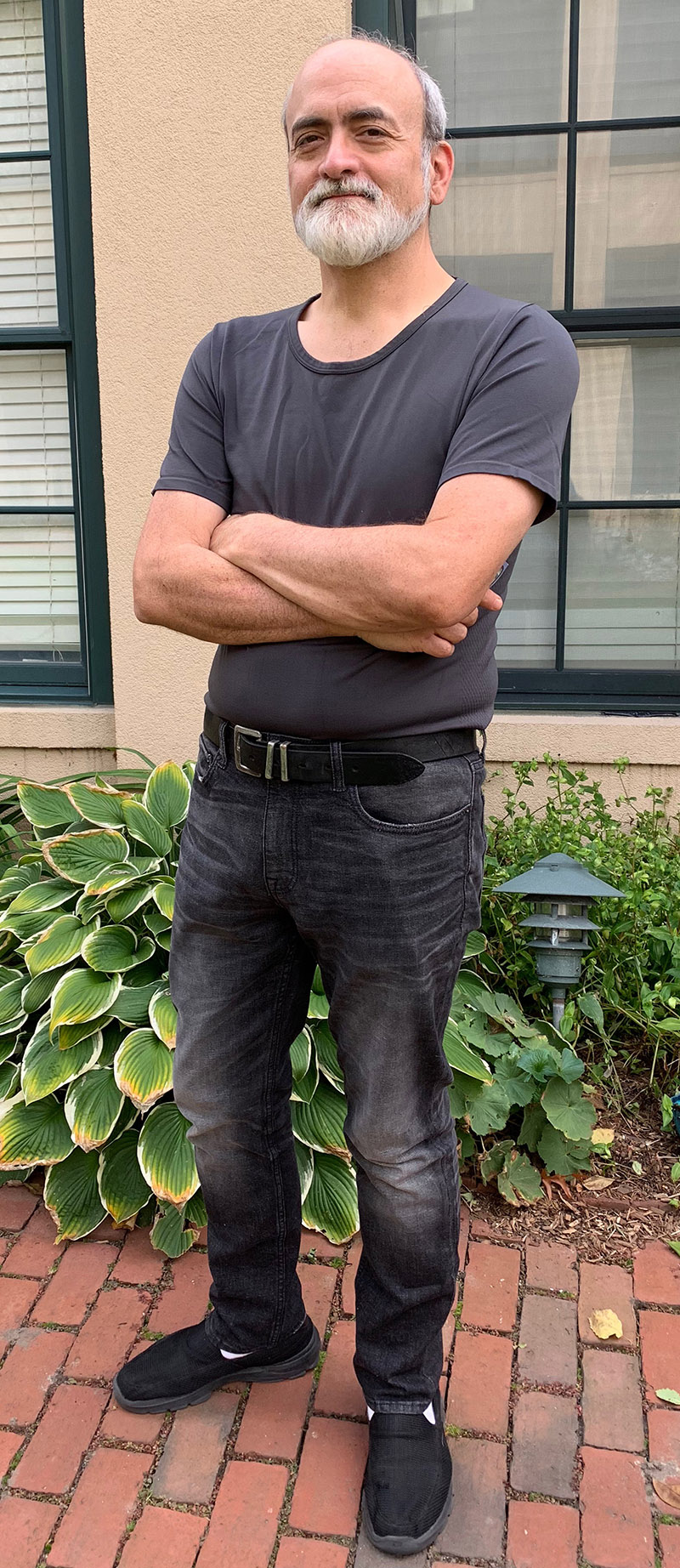
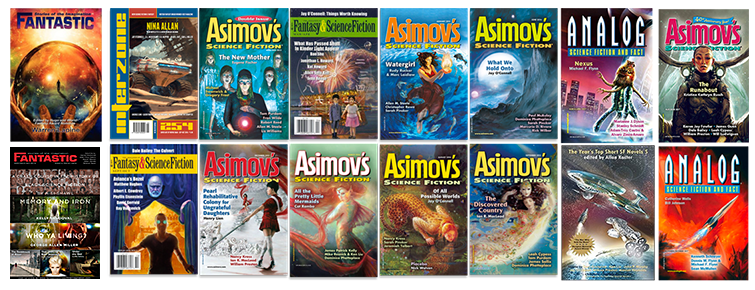
This poor son of a bitch has sold stories to Asimov’s (10) Analog and F&SF (more than one each, to those places.)
You can write. You can write in one of those three ways. Even in that most awful of ways, mine. You can succeed with all three ways. If my bibliography looks like success to you.
You can do the thing.
It’s the easiest thing in the world… to do badly.
And the easiest thing in the world to aspire to do, to pretend to do, and not do enough to really be doing it.
So let go. Let go of expectations. Fall in. The secondary creation calls out like young love on a cool summer night. The universe you own, or the one that owns you is out there… waiting. It wants you. The world inside. Shrink into it, fight the monster spider with the needle and plunge between the atoms and alight on a tiny worldlet inside a single atom and set up shop.
Alpha zero isn’t a stupid brute force engine, either; in fact it looks ahead far fewer moves than its opponents… who are also computer programs. But ones written more directly by humans.
Alpha Zero, more or less, wrote itself.
I had thought that SF writer Vernor Vinge had invented the idea behind this real world realization of a Super intelligence explosion, but it turns out that this idea has been around since the 60s, dreamt up during one of AIs many false dawns.
Let an ultraintelligent machine be defined as a machine that can far surpass all the intellectual activities of any any man however clever. Since the design of machines is one of these intellectual activities, an ultraintelligent machine could design even better machines; there would then unquestionably be an “intelligence explosion,” and the intelligence of man would be left far behind. Thus the first ultraintelligent machine is the last invention that man need ever make, provided that the machine is docile enough to tell us how to keep it under control. … It is more probable than not that, within the twentieth century, an ultraintelligent machine will be built and that it will be the last invention that man need make.
I. J. Good
So, this is terrifying, but the worst thing, or best thing, if you get to monetize the product, is that Alpha Zero taught itself Go and Shogi as well, again in a few hours, and now it’s the best at them, too.
These games are similar in many ways, and reassuring articles now abound explaining how far deep learning is still from real intelligence, general intelligence. One has to wonder if one day we get general intelligence, too–without ever understanding what it is. What we are.
Because we don’t understand Alpha Zero. The code just works. It knows more about chess than any human ever will, it plays elegantly, masterfully–at times it seems to toy with its opponent, rubbing their nose in their leaden brute force clunkiness.
The article goes on to talk about other deep learning applications that could soon make a serious impact in medicine–diagnosing brain injury about as good as a human doctor with decades of training and experience… but hundreds of times faster, and, though the article never says it, about a million times more cheaply.
Like many tech articles, even as it lays out a economic apocalypse of white collar work, with all of new revenue presumably flowing to companies like Google, who ‘get there firstest with the mostest’, there’s the presumption that capitalism will deal with this elegantly.
Progress is awesome! Everyone put out of work by this product will be able to afford the products created by their replacement! Somehow!
Even though these products, built on bazillions in public-spending to get the whole computer thing going, will be priced by giant global brutal monopolies.
We appear to be standing on the lip of the abyss.
Just as fisherman gained the ability to catch every fish in the ocean with high tech, the 1% has gained the ability to utterly capture the wealth of the middle class. IE, 90% of the consuming class. They have done this by reaping disproportionality the productivity gains of the information economy.
Technology may be neutral, but new tech is expensive, and when it is instantly weaponized by the shareholding class, we see that inequality is now tracking the curve of the approaching singularity.
Here’s another thing. The consumer economy doesn’t work without consumers. Your iphone factory is worthless when nobody can afford the new iphones.
So the owners of Alpha Zero and its split-second educated and manufactured slave children, will have two choices.
A new feudalism where 99.99 percent of the wealth is held by .01% of the population. Just keep adding nines on the one side and pushing the decimal on the other.
Or the shareholding class will have to manufacture consumers somehow. Whether that’s basic income, or subsidized work, or labor laws that partner human workers with super-smart AI pals, is unclear.
But we are at the point where the owners can, if they want, catch every fish in the sea. And then starve to death. Or rather, starve us to death, presumably hiding in fortified bunkers till we’re gone.
Alpha zero, at this point, is too dumb to care what happens.
In my Zeitgeist stories, general intelligence emerges in the next few decades and then spills into the environment. It takes whacks at these big problems too.
Short answer ? I wrote about 200k words, which is like two good sized novels. Though I didn’t write novels.
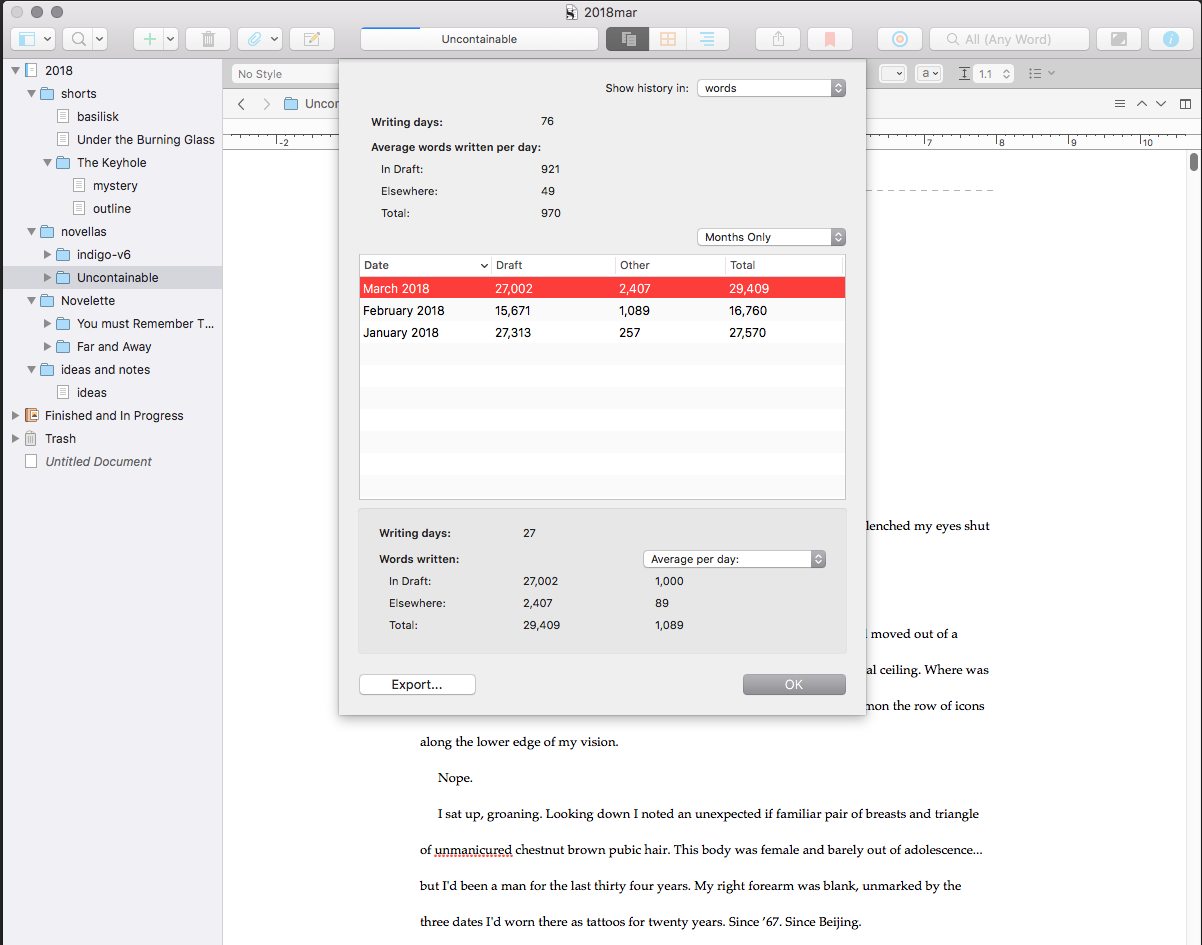
I think that’s the most I’ve ever written. My word count system (putting everything in one Scrivener file) stopped working as I cut and paste stuff back and forth to incorporate edits from beta readers, so, I ended up measuring the final products and not counting some words written.
I’ll firm that system up, or rather, replace it, this year.
The bad news, which will surprise exactly no one who knows anything about writing, is that I made less money than I ever have in my life—the year I spent the most time writing, wrote my longest pieces, and finished four of them.
I sold two shorts to Asimov’s, which was cool. The first has been out for a few weeks… no one has spoken to me about it yet, which I guess, is okay, as nobody has told me I’m a bad person for having written it. So. That’s maybe all I should hope for.
Like my previous story. The Best Man, I’m stumbling about in the minefield of identity politics trying to write stuff that feels true to my spirit, that feels like what I think of SF, that thrums with the moral ambiguities that I think fiction is meant to explore, and that incorporates my own journey parenting two GLBTQ kids. I’m living this diversity moment, from the POV of one of the usual suspects, trying to figure out what my contribution should be.
No consensus has pronounced doom on my efforts to date. Though a few sensitivity readers have gently explained to me that my stuff, ‘isn’t written for them.’ Which is of course, a kind of failure…
Still. I have Asimov’s, Analog and F&SF behind me. For now anyway. This keeps me going.
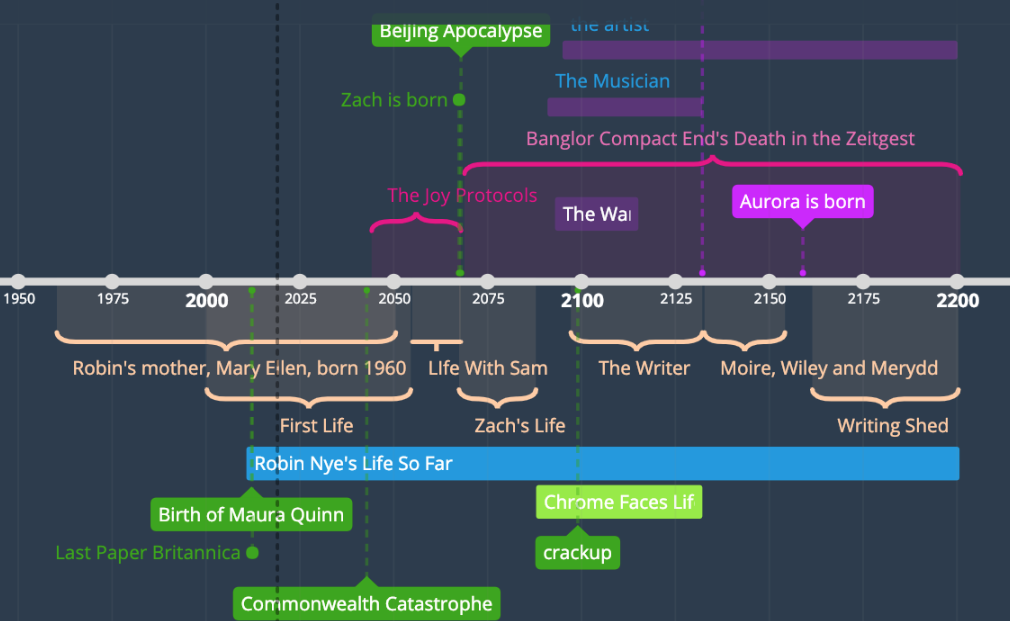
I wrote three SF novellas set in my Zeitgeist universe, a post-singularity near future. The three novella’s required a timeline, which I built and include a snapshot of above.
My third short story published in Asimov’s, Solomon’s Little Sister, is set in the Zeitgeist timeline, more or less (though it may need tweaking as it was the first one I wrote, before I realized I’d need a timeline.)
It remains to be seen if these novella’s will make it to professional publication… which puts me in this awkward position of reconsidering if I want to keep building out this universe at all.
Nobody is clamoring for more stories of course, after the one.
The Zeitgeist universe is sort of about human motivation in a post-scarcity world, the meaning of life, which is of course mostly a first-world kind of problem? Most people are simply surviving; the meaning of life for many is figuring out how to keep living. Once we have a universal base income, or anything like it, What does life mean?
Of course I still manage to find life and death stakes in this universe.
I’m not going to tell you what she told me, you’ll have to google it yourself or preferably read my story.
The Gorgon is an idea story, but written in the modern way, where the idea is basically a kind of casting call for the characters and plot to compliment the idea.
Not the characters and plot to dress the idea up in a thin layer of prose, you see. That’s the old way.
One of the things about the old way was the casting process. Who will reveal this idea? Some guys like me and the readers. White. Middle-class. American. Boom. There’s your story. You’re welcome.
Some of these old fans are now, frankly, pissed, when a story’s POV is, say, a woman.
“What about this story requires the POV to be a woman?” They sometimes say. Innocently. Not Getting It.
What about a story requires POV be a man… they don’t ask, because that was the default. Why are you shifting the default? Some ask innocently; mostly, now, this is followed by something about SJWs and Virtue Signaling.
Anyway. Nowadays, when I do my mental casting call for the story, the usual effortless white male het cis middle class dudes all show up…. but I try to search the crowd for someone more interesting.
There’s two ways that someone more diverse can be interesting.
One, their diversity echoes some metaphorical subtext you are working with.
Two. It doesn’t.
When it doesn’t, you’ve flipped the default… just because. Because fuck the default.
So this was an idea story… and here’s the spoiler alert.
I made the characters presumably white middle class… bisexual / pansexual though neither character overtly identifies as either.
I have compassion for both these characters, one loosely based on a guy I worked with in the tech bubble, the other a friend who worries about being a sociopath. Mixed with other people blah blah blah, you know, standard drill, these aren’t direct portrayals but there are real things in here.
Where did these character’s sexuality come from? Am I virtue signaling?
No, because these characters aren’t model citizens. One is casually racist; one is unreadable, as everything he says he says to manipulate.
Am I saying that sexual minorities are sociopaths and racists? No.
The idea story casting call required these types, these kinds of people. But I let diverse characters be cast anyway.
When both my kids came out as GLBTQ my family made the conscious choice to seek out more friendships and relationships with potential role models. These minorities became part of my internal landscape through a thousand meetings and stories and books. So they emerge in my stories, more often than the one in ten rate that one might expect, were fiction to be a demographic mirror.
Am I allowed, with my identity, to portray a diverse character negatively? That’s the issue isn’t it? Do I reveal hidden and implicit bias by doing so? Or, have I reached a place where my diverse characters are no longer cardboard model minorities, GBLTQ BFFS, and other assorted forms of window dressing?
I don’t know. I don’t get to know. Seems like I gotta do it though.
If you’re a spec fic writer, who seeks to write about Others like aliens, fairies, ghosts, AIs, seems like you oughta be able to write women, POC and GLBTQ beforehand. I mean. If you won’t investigate and portray the variety of lived experience within your own species…
Anyway. Hope you like the story. I run the risk of alienating old fans with the flipped default, and new fans, with the non-model-minority portrayal. The only way out of the box is to do a very good job. Do it right.
Hopefully I managed that. Asimov’s thought I did. So I’m going to keep trying. Keep flicking away from the default. Trying my best.
The parallels with real addiction, substance abuse, are uncanny.
You try. You succeed. You try to meter your intake, build a system to manage your tendency to spend way too much time and effort on social media… and you fail. You fail hard.
One reason you fail? Because you can’t turn to social media to help you get off social media. And social media has hollowed our our traditional connections to each other, taking what existed before, our demonetized, data-free friendships, and converting that impulse into eyeballs, data, influence, and cold hard cash.
Mostly for Mark Zuckerberg.
Sure, non-profits use it and businesses–they have to. But the cash isn’t shared with the content creators, whose personal data is what Facebook brokers, of course.
That is not how tech billionaires are made.
Leaving the angry socialism aside, (which is way hard for me to do) I’m left with what is within my power to change. My own behavior. And how I interact with the networks of people who help keep me alive; who I help as well.
With this in mind, I have commented on a few friends posts this year, and shared a dozen things. But I haven’t written a post. The part of my brain that listens to the news and instantly begins composing my own brand of amateur citizen commentary chatters away without any form of release.
So Sigh. Here I am!
Welcome to my methadone maintenance program.
As a friend of mine said, my stuff is fun to read because it isn’t monetized, or monetizable. Typo riddled but readable, with a strong voice, profanity, and unfair reasoning by analog, with the occasional novel reasoned argument thrown in for good measure. The infrequent valuable connecting of the dots compiled through compulsively reading real journalism…
But really, mostly, the only reason to read me is that I get to say fuck, and the stuff that Paul Krugman will say a few hours later in the day, in copyedited form, with the power of a Nobel prize in economics behind it.
Meanwhile, I don’t make a living wage as a writer and I make, near-zero dollars writing at FB. Full stop. ( I forced fifty friends to buy an anthology once with a series of posts and videos and small ads, earning less than 100 bucks. I could have made more in that time collecting cans. I won’t do that again.)
I write for a few hundred or a few thousand readers, in the stories I sell to national magazines, the people who read my feed, the occasional shared post that is widely shared. (but only viral a few times in my, eh, ‘career.’)
I love writing and knowing people read what I write. When I write in my blog here, I can see, clearly, the readership as hits. A tiny number of hits. In FB, I have to translate likes into reads in my head. Except in my vendor account, my pro author account, which nobody ever looks at, and which FB flogs me to advertise.
In my amateur columnist / memoirist role at FB, there’s a random reinforcement schedule. Some things get dozens of shares and likes. Some get a handful. Some get none.
And as we all know, the random reinforcement schedule is the addictive core of the gambling urge. It draws marks to the casino table, the stock market, and to social media, looking to hit it big, with a viral hit that will redeem the activity financially.
But I’m ten years or so into this thing, and my ‘career,’ as Paul Krugman’s little typo-riddled non-nobel prize-winning brother with no hard skillset, but who gets to say ‘fuck,’ has probably accomplished all it can. So be it.
For all my belly-aching? I loved every second of it.
I’m going to go write a marketing post now for a good friend, which I’m gonna say doesn’t break the no posting rule.
I’m going into the bar just to get a soda. For real.
I guess it’s one day a time. Day 3, no posts yet. We’ll see if I get to 365.
Reading the feed and not posting is very hard. People’s relatives and pets die. People need answers to questions. People need support.
I’ll come back in 100 days, and tell folks that they can still ask for support, here, at the blog, or in personal messages or face to face meetings. I’ll check messenger–everyone know FB was letting companies access the actual content of these messages for marketing info, right?–to tell the few folks who really dig my stuff I haven’t been hit by a bus. I’ll get a half dozen of those messages.
Otherwise, that’s it. I’ll post here. When the readership is ten people, I can scale this effort down to what talking to ten people is worth in terms of money / career… which is fine! I pay ten bucks a month for this site. I should probably move it to free-wordpress, if I feel that the site hasn’t earned me 120 bucks of readership in a paid product.
On the brink of a breakthrough I grew fat with despair
Down 200 sticks of butter from Peak Fat. A man as thin as a twenty-nine year old, with a curiously long torso.
A year into the ongoing tragedy of the Trump administration I had packed another fifteen pounds into my fat suit, the one I’d been working on diligently since my twenties. This is the fat suit most Americans don as they age, swapping a pound of muscle for two pounds of fat each and every year.
I felt like shit. I wasn’t sleeping sleep well, I had gastric issues, but eating three to four thousand calories a day helped stave off panic and kept my depressive mood swings barely in check. My mental state induced a suite of symptoms leading to expensive medical tests which showed nothing deeply wrong with me… besides the thing my doctor had begun to mention at my yearly checkups. I was, at 240 pounds and five foot ten and a half inches, clinically obese.
I didn’t really feel obese, though, and when I mentioned this people said I wasn’t, meaning, really only that I didn’t look morbidly obese, which is really what we commonly understand that word to mean.
I’d been a skinny kid and an average weight young man…. what happened? Was I cursed with some metabolic slowdown? Bad microbiome? Thyroid condition.
No. I ate too much. I have alcoholism in my family, but have been spared that, but food has always been my weakness. I’m a good cook… and an even better eater. I love food. All food; organic, healthy, vegetarian, vegan… and factory food, fast food, snack food, meaty and fatty food. Ethnic food from every nation. American diner fare. Crappy-crass parodies of ethnic food. Lousy New England Chinese restaurants.
Taco Bell.
Hey what about the writing?
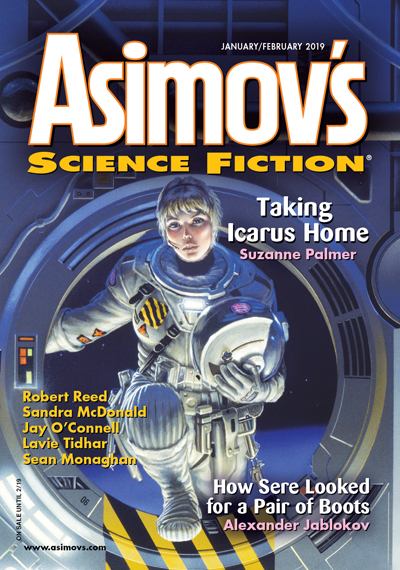
I’d broken into the big SF mags at age 50. Yes, I use this graphic a lot.
I knew another three to seven years of this was going to kill me. I’d also realized, after publishing a dozen stories and novellas in the SF pro-press (Asimov’s, Analog, F&SF, Interzone, FSi and others), that if I ever wanted to do this writing thing, I had to do it now. Time wasn’t on my side. I could stroke out, become demented, or die, at any minute. Of course anyone can pull a Stuart Sutcliff, but I’d reached an age when, as the late Louis CK put it, there would be no candlelight vigils at my sudden unexpected passing.
Most of the writers, artists, scientists, important people I’d read about had done their best work long before age 55. If I was ever to do anything, I’d be an outlier. Any success was growing more unlikely day by day, week by week, year by year.
The remnant of the energy and excitement at my big magazine breakthrough at age fifty was washed away by the national tragedy, and my work failing to trigger any observable, measurable change in my life. No awards, nominations, TV or movie options, no interest from agents for anthologies… all things happening to friends of mine with similar credits. I’d passed one hurdle but this proved just another milestone in a long slog that again disappeared to the vanishing point on the horizon. Still, I couldn’t stop now. I didn’t want to. I was publishing regularly in the top magazines in the field.
But I was grinding to a halt. Writing wise, I’d picked at a novella for months, while doing my usual freelance design, a little activism, a ton of Facebook Ranting, and nothing else worth mentioning.
But with the support of friends and long-suffering family I began to shakily, fitfully, pull myself out of the mire.
Pysch meds, which I had long avoided, were the first step. While I know from personal experience that pysch medication can save your life I’m agnostic about their ability to fine tune one’s mental state; chemical intervention is always a double-edged sword, and I’d hoped to treat my various borderline clinical issues in other ways.
Trump changed that, in the first months of his ‘presidency,’ while viciously attacking, debasing and insulting almost everyone who wasn’t an aging white ultra-rich guy. Non-aging-white-ultra-rich guys, IE, 99% of my friends, around me were regularly dissolving into tears, fits of screaming rage, or near catatonic despair.
I alternated between these three states myself.
As they say in the airplane safety dance, first put on your own oxygen mask, then help others paralyzed with fear.
I started reading what I have always called ‘self-help crap,’ fitfully, in an annoyed fashion. Reading the blogs, the books. Successful friends recommended to me what had helped them. I held my nose and entertained the notion that I didn’t know everything about how to live my life.
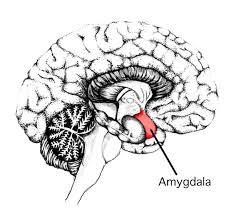
If you speak science-ese you can look at the study here. The TL:DR is this: A bunch of random people were given index cards with a mini-course on mindfulness meditation, and in 8 weeks, they changed the physical size of their amygdalas. In fifteen stinking minutes a day.
Not reduced electrical activity in the region. They shrank the gross physical mass of this nightmare inducing part of their goddamn brains.
They didn’t have to scale mountain tops, or learn how to speak Martian. They read a card and sat in a chair and did a certain special kind of nothing for, and yeah, I’ll say it again, fifteen lousy stinking minutes a day.
So I added meditation to the medication. And one day, while looking at myself in the mirror, I pivoted to that sideways view that is always so, so disturbing and thought to myself, grabbing the thick pad of fat that now filled out my silhouette transforming me into a barrel of man—
Fuck this. Fuck this shit. Seriously. What the fuckity-fuck. Who the fuck is that? Having just meditated, I said all this calmly without throwing things or clawing at my abundant flesh. (have I mentioned the Zen is a work in progress?)
I asked myself, ‘how did I get here?’
Letting the days go by. That’s fucking how. You fuck.
And I remembered a moment as I approached the age of thirty where I thought to myself, “Considering the alternative, I have to turn 30, but do I really need to get heavier than 200?”
I have fat friends, and I have embraced, and still do, the basic tenets of fat acceptance, that shaming and judgement of others based on weight are bullshit. I had unfriended people for preaching the gospel of universal weight-loss to some of the larger bodied friends in my feed.
But the body in the mirror didn’t look like me, to me. Nobody was giving me much shit about it; even my Doctor. The advancing case of Old I could do nothing about. But the fat? Maybe. I could get under 200 pounds again. Maybe it wasn’t going to make me healthier. Maybe it was arbitrary. Maybe it was vanity. A mountain to climb for no reason.
But to tread that lightly on the Earth again. What would that feel like?
The writing thing? Same basic plan. Use a scale. Measurable goals. Read the work habits of Very Successful people. And Try. I had already set a word count goal for the year. Successful pulp writers crank out between 500,000 to a million words a year. (five to ten novels). I’d shoot for 300,000.
The mental health thing? Medication and Meditation baby. And maybe progress on the goals would help, too. My writing program, Scrivener had a word tracking system built into it.
Which was good, because I suck at data entry.
Okay, it’s worse than that. I suck at any and all forms of discipline, any and all regularity of pattern, any and all structure. In short, any time I am compelled to do anything like a metronome I feel the desire to stick it to the man, and not do the thing.
Even if I am the Man!
So I was going to have to build new habits. I’d learned that one recipe for failure is to try to turn your life around all at once. To use force of will to simultaneously tackle many weaknesses. Because you don’t have that much willpower. Trying and failing to adhere to fanciful work plans had proven that already. What I hadn’t known, until I did my reading was that nobody has that much willpower.
What successful people have is habits, cultivated over time, which they added to gradually, habit by habit. Being creatures of habit (supposedly) their ability to become ruthless self-actualizing world-beating success machines grew exponentially, as they built habits inside of habits in nested epicycles, hung habits on top of habits, and habitually kicked the sorry asses of seat-of-the-pants, winging it, late sleeping slackers like me.
Or rather people that acted the way I was acting.
How do you start? How did I start? One habit at a time, dude. With the keystone habit. The first habit. The mother of all habits. Unbeknownst to me, I’d started the work. With a pill. And an index card of meditation instructions handed to me by a scientific study via the NYT. With a selfish grasp of Maslow’s hierarchy of needs as illustrated by the Airline Safety Dance.
Put your oxygen mask on first.
Build a better life one habit at a time.
Start at the bottom of the pyramid… and work you way up.
Stay tuned for Part 2: Gamifying Everything: On Becoming a Cyborg and the Quantified Self
So, let’s say there’s this amusement park, which is huge. The size of a continent.
And the people who live and work in it are pretty well off. People come to visit the park; some people come to live in the park; a few people jump over the fence, to avoid paying the turnstile fee. And one in a million of those people who jump the fence are on Most Wanted posters. They jump the fence, too.
So the money folks at the park run the numbers, and discover that, on average, the folks that jump the fence, buy enough stuff at the park so that the park makes money. It makes a little less than it does on the folks who pay at the turnstile, in some cases, on average, but overall, yeah, the park makes money on the jumpers.
Park security has its own job, keeping the park safe. It collects data on the pickpockets and muggers in the park, and it finds out that, on average, the fence jumpers pick fewer pockets, get in less fights, and rob people less than people who pay the fee at the gate.
Now. Here is the part where my analogy breaks with reality.
Most of the people in my analogy are reasonable. They use data to justify policy.
A horrible mugging occurs. A one out of a million thing. And the mugging, which ended in a death, so it’s a murder, was committed by a fence jumper. The money person and the security person and the marketing person all meet to figure out what to do.
Our mugging numbers are pretty good, overall, but they could be better, Security says. Give us more money if this issue is affecting overall operational goals.
Wait, the marketing person says, the person who did this jumped the fence. Shouldn’t we work on the fence?
The security person and the money person exchange a look. “No. That’s a waste of resources. There are two things we can do. We can spend more on park security in general. Catch more muggers. Don’t worry if they’re fence jumpers. Most muggers are paid customers anyway. Those numbers go down. We can afford to spend X more on that without eating into the bottom line too much, the money person says.
The security person agrees. “Yeah. Give us more funds. We catch more bad people. The fence jumpers aren’t worse than the average park goer. But don’t worry. We check the Most Wanted Posters at the fence. So if a fence jumper is a real bad hombre, he gets evicted hard.
The marketing person, the least smart and most emotional person there, gets all pissed off. “Well then. Just tear down the gates and let everyone in free, I guess, is what you’re saying. Free park. Build all the costs into every ride. We all take our chances! Fence Jumpers! Cat’s and Dog living together! Anarchy!
No, no no, the money person says. The model basically works. We don’t want to do that. The fences work about as good as fences work. The slippage doesn’t cost us money. And it doesn’t make us less safe than, say, making coupons and letting more people in the first place. Nobody here is saying ‘open park’.
The marketing person is now wide eyed, frothing. Fence jumpers! Murderers! Rapers! Fence jumping murderer raper jumpers!
Please shut up, the money and the security person both say. We’ve explained the rational options. You’re being an asshole.
But what about this thing? the Marketing person screams.
We’re lucky, the money person says. We live in a metaphor where most people are rational, except for you.
What we will do is check the most wanted posters at the fence, and everywhere else, and spend more on security evenly applied to everyone when we feel insecure, and accept that the fence jumpers make the park money, that other than the jumping they’re the same or more profitable than regular park goers, and that overall, we are a better and more profitable park, with the fence built to the level it is now.
Oh, and nobody wants to tear down the fence, nobody that matters, anyway, so shut up about that. Your hysteria doesn’t move reasonable people.
Because we are people who can look at graphs. People who reason by data. People who respect numbers. People who recognize say, that getting on a plane is safer than driving 2000 miles, even if they feel safer behind the wheel, than trusting a pilot. People that know seatbelts will save them ten times more often than they will trap them in a burning car. People that know vaccines save far more people than they kill, who still want vaccine making and selling regulated.
People that know that, in the rare occurrence they are mugged and or murdered, 95% of the time it will be by people they know. From their side of the fence.
People that know that getting super upset about the fence is really a symptom of something else entirely.
People who have decided not to let that something else rule them.
Very pleased to announce the sale of my short story, “Not Only Who You Know,” to Asimov’s.
A little near future spec fic, a little romance, a little crime fiction, a little social commentary… I’m happy with how it came out.
I am making my 1k a day goal for 300 days this year, though I don’t write evenly, some days are more productive than others, and some days are lost to the real world.
I’m a bit behind now. I’ll pour it on and make my deadline, I think.
I’ve lost 25 pounds in the last seven weeks or so, on purpose. So, I’m counting calories, and counting words, and counting steps, my Self fully quantified.
I wanna thank my workshops, Neopros, Mechanics, and B-Spec, for all their help over the years, Sheila Williams for helping me fix the broken bits of my stories, my friend Celeste for being Celeste, and my family for giving me the time and space to write a lot. A lot for me anyway.
At the end of the year I expect I will be pushing just as hard, just as frantically, for more clients and more freelance work. But I’m not worried about that now. For now I am doing this. As hard as I can.
Or is it easy? What could be easier than falling into your dreams.
The hard part, really, is leaving them to live in the world.
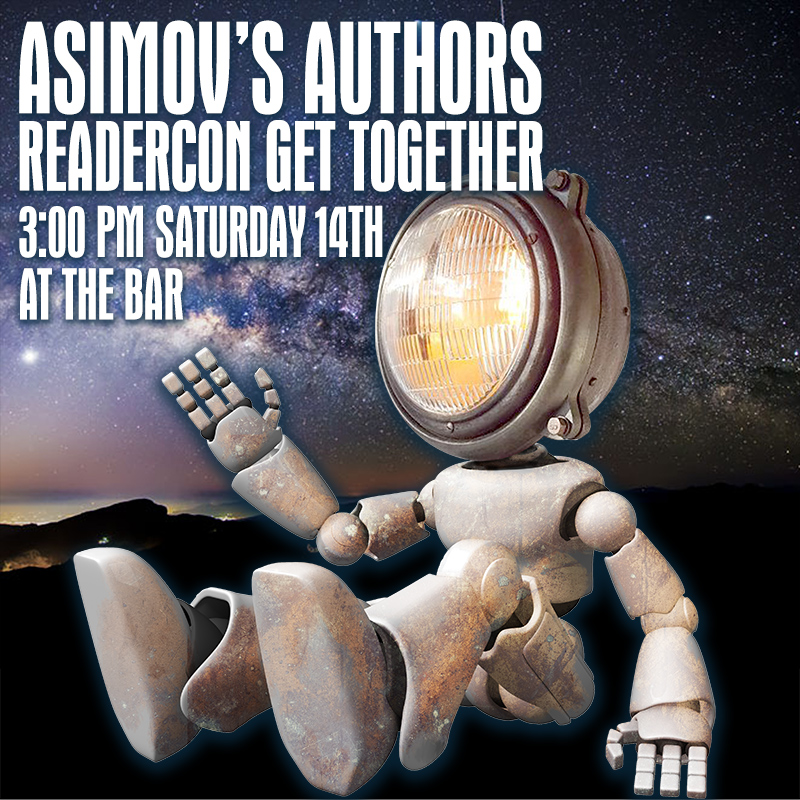
I will be hosting an Asimov’s authors get together in the bar at Readercon at 3:00 pm on Saturday July 14th. Sheila Williams, Asimov’s award-winning editor will be attending, if everything works out as planned.
Chime in, if you can make it; if you know of Asimovians feel free to invite them; have them RSVP if they want to following up on my public post, or email me at ejayo1963 (at) gmail.com, or just show up!
Let’s try to celebrate the magazine and discuss the work, and not get sucked into a lot of discussion of the current dystopian hellscape!
Let’s enjoy the weekend!
Hope to see as many as can make it there. Feel free to comment here or on my Facebook page!
I want to briefly thank everyone who I have met through the magazine for being awesome to me. Thank you! Thank you. You make this whole thing feel a lot less isolating.
So if you follow me on social media you may remember that I have committed to writing 300,000 words this year.
This isn’t a huge thing, really, by indy standards, though were I to publish them all traditionally, that would be an outlier. If you’re not a writer and you think of writing in pages and not words, here’s a link for the lengths of famous novels.
Oh, all right, I’ll convert that into pages (even though pages vary in lengths for lots of reasons). Call it 3000 paperback tiny print pages.
When J.K. Rowling was constrained by industry standards vis a vis optimal YA novel length, that would be about 3 Harry Potter books like the first two. Of course, she became J.K. Rowling at a certain point, so at 257k, Order of the Phoenix would eat most of my 300k year, with an additional short novel, say, The Great Gatsby, tossed off in the last two months.
So far, this is working well for me. I have hit my target at three months in.
I have finished 2 novellas, 2 novelettes, one short story, and am halfway through another short now. For fun, I will name them.
Indigo
Uncontainable
You Must Remember This
The Keyhole
The Gorgon
Far and Away
If you are considering doing this, setting a writing goal, jigger the rules of your writing game to help you do the thing you need the most. My problem, I think, has been a slow process that doesn’t include proper drafting. I haven’t written bad first drafts; I have agonized, growing stories very slowly, I call it ice-sickling, rereading and rewriting endlessly as I go along. If you are a pantser and want more plot, be sure to count your outlines.
What Not to Count
The one thing I urge you never to count, ever, is your social media and email output. Writers fool themselves into thinking they’re platform building with this kind of thing, when they really need to be writing more books and stories. Mostly what you do in social media is make Mark Zuckerberg, and Google, which people use to find your content, a tiny bit richer. The value that adheres to you is negligible.
There are exceptions to this. John Scalzi and John Green come to mind. But they have written their fiction at a good fast clip and don’t seem to suffer from time in social media. If you aren’t finishing a novel or three a year, I’d look into social media use. It is probably a tail that is wagging your dog.
Twitter might be an exception, tweets are dense and crafted, or should be, and if your content generates a ton of followers…. well. As an editor of an online magazine, I noticed a strong correlation between story reads and Twitter numbers. And a youtube channel actually generates a little revenue. Podcasts consume a different kind of energy and should include human contact, even if it’s a phone conversation or skype call being turned into content, and again, you own that content.
But Facebook is a complete and total disaster. Believe me. Try marketing reprint anthos to your 1000 friends. This gives you a great idea of the monetary value of that relationship as mediated through Facebook. Don’t hate your friends. Hate Facebook. Because you’ll never know, when your stuff doesn’t sell, how much of the failure is genuine ambivalence, and how much is FB gaming the system to sell you ads. Because Facebook is built content they get for free, which they then turn around and charge the content providers to show to people.
Often people who have signed up to get the content!
Facebook sells your own friends back to you.
So, repeat after me, social media is a giant suckhole of time and effort.
That includes stuff like this blog post you’re reading now of course.
Rules of The Game
Pick a number of words for the time period. Figure out how many writing days there are in your time period. Do your math. Give yourself days off. When you miss your goals you can burn them if you have to.
Do not subtract for edits. Throwing words away is important. If you penalize yourself you can’t edit properly. Scrivener has a setting for this; Not sure how you would do it otherwise. A rigorous drafting process would work.
Count your outlines. They’re very dense and time consuming. Don’t worry that you’re counting something twice. Count your story bible, and any idea files you keep.
Don’t count social media writing or blogging or any form of conversational typing.
Pick an easy per day goal; figure out how many days you can work in your year, how many writing days. Do not stretch in this part of the goal. If this is 200 words a day five days a week for fifty weeks with two week vacation, congratulations, you could have written Vonnegut’s Slaughterhouse Five in a year.
This is the hard part. Do not let yourself off the hook for the cumulative goal.* What this means is that as you slip and lose days, to slow edits, to life, your new word goal will rise and become more challenging. This is why you picked an easy one.
Study your workflow. Maybe now you have too many shitty first drafts. One of the downsides of nano-wrimo for many are hastily written novels that nobody finishes. Finishing is when you level up. It is when the Dungeon Master hands out experience points.
You have to finish. Some things can be finished in outline only. But you have to finish what you start in some way, or part of your brain will be sucking that lolipop for the rest of your life. That sucking may actually turn into something wonderful, but don’t count on that, ever. You’re better off finishing everything you can.
If you are writing stuff you know you can’t return to, you may want to stop and revise your goal downward. If on the other hand you look at the work and see something you will want to work with, keep going.
Common Observations on Goal Oriented Writing
So many, many pros say this I’m not going to bother to source it. The writing you produce when inspired, and the writing you grind out under your self imposed deadline will read the same. You’ll see no huge dramatic shifts in quality.
You will build a muscle you didn’t know existed.
You will become a better writer.
If you submit what you write, you will start selling eventually.
Risks and Dangers
If you have mental health issues, stress can trigger problems. This is a stressful activity. That’s the point. To use the stress to build a muscle. To use increased workflow to find a better process. I have noticed, for want of a better term, a prose module in my head that heats up and is hard to shut off. Characters will chatter at you. Story details will pop into your head constantly. You’ll itch to get to a keyboard to make sure you don’t lose anything. Why does this happen?
Writing is dissociation. Here’s a definition of that in psychiatric terms:
Dissocation is a separation of normally related mental processes, resulting in one group functioning independently from the rest, leading in extreme cases to disorders such as multiple personality…
Dissociation is any of a wide array of experiences from mild detachment from immediate surroundings to more severe detachment from physical and emotional experiences. The major characteristic of all dissociative phenomena involves a detachment from reality, rather than a loss of reality as in psychosis.
This detachment is your writing trance. It is what makes the solitude endurable and enjoyable. We don’t write alone. We write in the company of our imaginary friends.
If you take from this the idea that I’m saying becoming a good writer means you drive yourself slightly insane then you are reading me correctly. I am saying that.
So don’t break yourself. Adding heavy drug use, even moderate drug use, lack of exercise, lack of sleep, lack of all human contact, to a new writing goal is a recipe for disaster. Don’t try this at home. Take care of yourself.
But when you feel it’s time, do this thing with all your heart, so when you lay down to die, you’ll know, you did it. When the music stops, and you take your seat for the rest of eternity, you want that moment where you say.