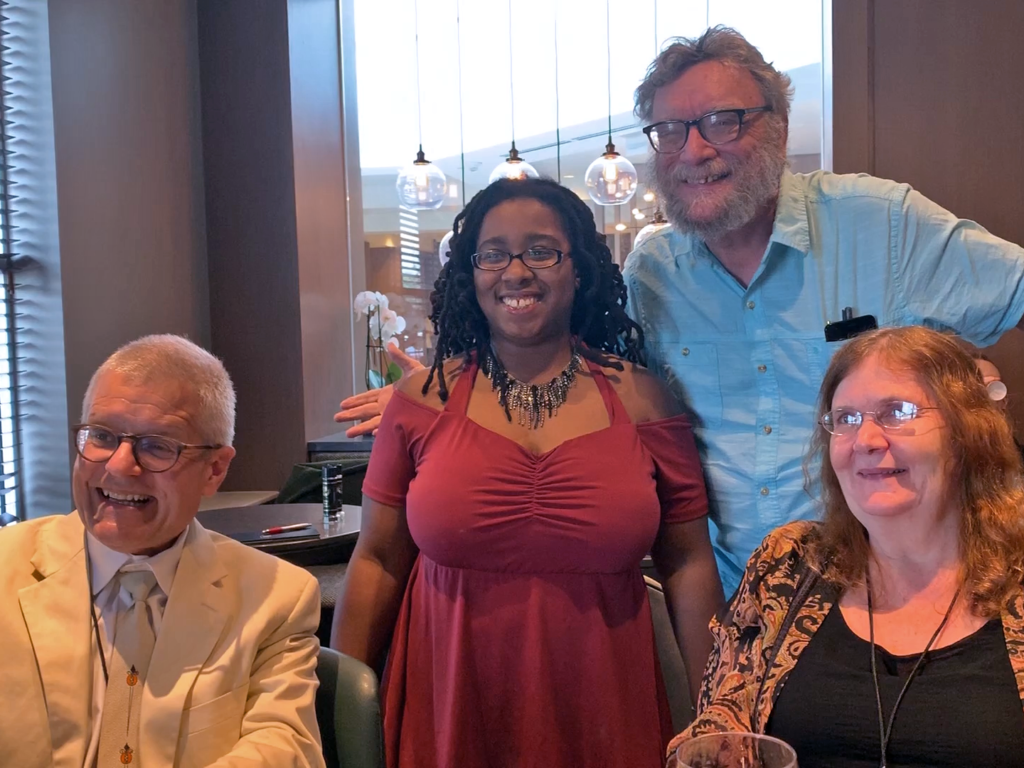
Left to right: Alex Jablokov, Erin Roberts, Michael Swanwick, Sheilla Williams at Readercon 2019
Because every time is a great time to be a writer. Let me explain. I’m not being an asshole. (Well, more than usual.)
It’s not a great time because of indy-pub (or self-publishing as it known to traditional publishers, who wish people would just call them publishers, like in the old days). It’s not a great time because of e-readers or social media sharing or the Golden age of television or kickstarter or Patreon.
It’s not a great time because fascism is on the rise in America and across the globe and this painful political awakening and resistance is sharpening the senses.
It’s great because you get to write, and as good as now is, better times lie ahead, because you will get better at this. Terrible times ahead, too, of course. But God you have to grab onto the good ones.
This paraphrases what Jack Dann told Cadwell Turnbull and myself at the Asimov’s table at Readercon 2019. (I think he was speaking mostly to Cadwell, whose first novel, the Lesson, I’d brought with me to be signed. The book evoked in Jack and the other successful novelists at the table memories of their first novels, and advice, real, heartfelt, ironic, mocking, self-deprecating sometimes pointed and blackly depressing echoed with the laughter and genuine good feeling.
It would be rude to quote it directly without permission, this wonderful moment of camaraderie and shared purpose, which I was glad to witness. (I haven’t sold a novel yet, but my publications had earned me a seat at the table.)
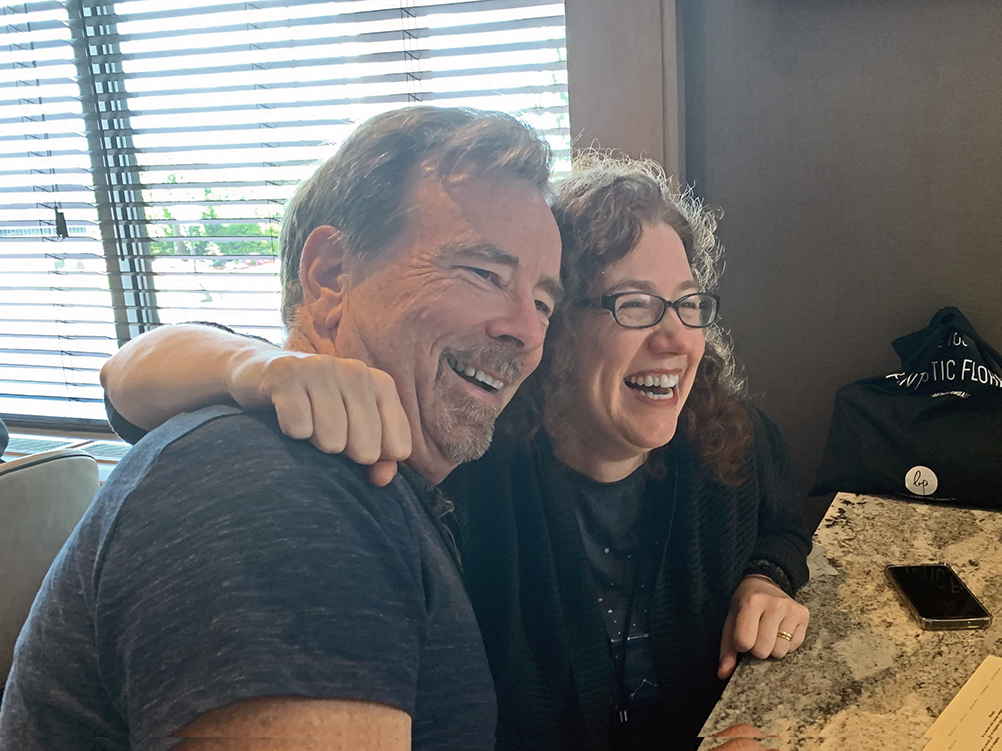
Jim Kelly and Sarah Pinsker
I tried to shut up and listen and enjoy the moment, too. I succeeded pretty well, as such things go for me. Feel like I’ve arrived. Though I will never arrive. No one ever arrives. And you have arrived the moment you write your first word. That’s about as good as it gets and it doesn’t have to get any better. But it will and it does. I hear. Think. Hope.
Calming and refuting the horrible voices inside me that say, “So where’s your novel? What’s wrong with you? You have proved you can do this now, what the fuck is the hold up, son? You’re sitting here poking at short stories and novellas and doing entry level graphic design for cash, having abandoned the corporate career, which is fine, for a goddamn twenty something. Thirty something. Forty something?
Fifty something?
But as the lunch winded down around dinner time Jack’s relentless clear eyed encouragement mixed with a funny, brutal honestly on the writing life was infectious, joyous. Jack was reeling from the hideous jet lag of his unbroken flight from Australia. Where is doing very well!
He has done great work and made great friends in this life.
And so will you. Maybe. If go and write now and take your piece of this writing life which is accessible to us all in bits and bites and sometimes huge delicious meals, and sometimes this becomes our lives, at any age, for some unknown number of years, because everything you have and gain will crash and burn, Jack told us. And you’ll keep writing, or stop, but you don’t have to. You never have to stop. And if you do stop you can start again, in a month, a year, five, or eighteen.
That’s me. The eighteen.
But you’re writing now, writing all the time, in your head, living your life, the voice I cultivate now whispers.
Becoming a writer is like being Mr. Orange in Reservoir Dogs. You will yourself into being.
There was a time when you had to tell people you were a writer one at a time.
In person.
Working your publications, your agent, your short-listed story in the year’s best, your zine, into the conversation was hard work. Just blurting this out, creating an awkward silence, was about as good as it got.
Still, the best part of being a writer, then and now, is that no one can make you believe you aren’t one without your consent.
John Kennedy Toole wrote the book Confederacy of Dunces, couldn’t sell it and killed himself in despair. Eleven years later, due to the efforts of his mother and Walker Percy, the book was published to critical acclaim and became a canonical work in southern literature.
If you want, you can skip the despair, the suicide, and just be John Kennedy Toole. You’ve written a classic. Everyone else is wrong about it. You’re a goddamn genius.
Anyone you are talking to, who says they’re a writer, might be a genius.
You can’t prove to them they aren’t.
And the evidence of your industry, as a writer, can be modest. Stacks of manuscripts tied with twine. A pile of hand-written moleskin journals. Nowadays? It can be a thumb drive. “I have written over 100 novels that will be beloved by generations. They’re all on this.” Wave thumb drive. “I’m looking for an agent,” is a good way to end that conversation.
Artists kinda need studios, and gear, and they produce stacks of physical stuff, and if they can’t sell it, the stuff piles up.
A writer, at a certain point, might build a shed. Maybe. It’s not necessary.
So. You can write a bit. Then think about the next thing you’ll write, for a long, long time. And in the meantime, you can meet other writers on social media and share a lot of inspirational animated gifs.
You can share your process, inspiration, craft tips, your agony, your ecstasy, pictures of your kids, your dog, your protest signs. You get to be a writer whenever you say you are one. Not an under-employed graphic designer, or a retired person, or a kid out of college living with his parents who can’t land a job or a person living on disability or a stay at home parent taking a career hiatus or a person working any number of dead end jobs to make ends meet or a trust fund kid who sleeps till noon and gets drunk every night. So many identities are hard to own.
You can pretend to be a writer instead of being those things.
And… you can always stop pretending, and write; write more; write every day, and work at making your writing as good as it can be.
You can fake it till you make it. Sit down. Make words. Slip inside them.
Be Mr. Orange. Become the bad ass you want to be. Talk yourself into it.
Fool everyone else. Fool yourself.
Accept that we are all fools.
Set aside the dog eared manuscript and write a new one. You’re most writerly when you’re writing.
My friend Amy Solomon was feeling despair as the new reports of massive, industrial scale child abuse paid for by our tax dollars spilled out last week.
“I can’t stand it,” she told me on Facebook.
After she created a candlelight vigil event.
We’ve all seen the places we should send money, and I think most of us have sent some, or we have continued to support the ACLU and other groups, maybe our democratic candidate, but there is something about paying other people to do this work for you that is not satisfying.
Creating this event herself felt super weird to me. Did she have a permit? What would it matter… 10, 20, 50, 100 people. Would we be hassled? Wasn’t someone organizing something later, bigger, where I could go where I was told, and chant in unison? Where the media could under-report the size of the crowd, and take pictures of the anti-protestors to run side by side with us?
I mean, did we have permission to do this? Then I laughed, out loud, not LOLing, but actually laughing out loud.
Did we have permission to do this!
I agreed instantly. I’ve learned that sometimes other people remind me of what I really want to do.
In response to the candlelight vigil (we skipped the candles and walked with signs) some angry person went off on Amy on Facebook, in that way people do easily on social media, about how the Trumpers don’t care about our protests or our sadness, how the time for that is past.
I wondered how to respond.
Angrily? “Fuck you. What are you doing? Fucking holier than though piece of shit, you.”
Then, less angry, “It may not do much, but the one thing I do know is that anything in the real world beats whining in social media, like you.” You dumb fuck. I leave that part off of course. I”m being less angry.
There’s the CBT therapy response, which goes, “I understand why you feel that way. I feel like that too sometimes. What are you doing that you think is more effective? I’m open to suggestions. You obviously want to stop this too, so we are on the same side.”
Then, I hit on the real response.
“Sorry you feel hopeless. I didn’t do this for you. I didn’t do it for the Trumpers. To some degree, I didn’t even do it for the kids in the cages, at the bottom of this, we do these things for ourselves, so we aren’t the people who do nothing.”
Not to be smug, or holier than thou, or delusional about how much impact we are having.
There is a great scene in the last season of Babylon Five in which Londo, a diplomat representing a fading power who dreams of making his empire great again, whispers to a mysterious alien in a bar. This leads to the Great War, that turns into a genocide Londo grows to hate.
When it’s over Londo is plagued by nightmares, which become a fatal illness. In his visions he confronts Gkar, a diplomat for the race swept into camps and slaughtered.
“There was nothing I could do to stop it! I would be court martialed and shot!”
Gkar explains without rancor that Londo had to do something anyway.
It didn’t matter if anything he did could possible work.
Londo had to do it for himself. You have to do this for yourself.
To be a person you can live with.
You can’t make anyone in this world do a damn thing. As Robert Heinlein said, the worst you can do is kill them.
The only person you control, is yourself. The only real voices in your head are your own.
Tell yourself to be the person you want to be. It’s the only way you become them.
Your ideals, your humanity, becomes worthless when you don’t, and you might not consciously know it, but that voice inside reminds you, deep down that voice you conjure, knows if you are lying. It knows you.
Either way. Do this for yourself, your best self, and or your God, if you want to think that way.
And even if all the protest signs do is mark you for ridicule, for persecution, you still have to hold them.
We all have negative voices in our heads. What they say varies from person to person. In people who are depressed, or anxious, or bipolar, these unwanted thoughts can become part of a downward spiral that drains the joy from everything, including writing.
If you are wondering why you can’t write, which you used to love, and also find yourself uninterested in anything, except sleep, you may need more than writing advice.
If you are a person of faith, be careful about getting treatment for depression based solely on that. Here are some things to look out for. (this link is to a Christian site that might help you figure out what to avoid. In general, I’d say look for someone secular, but that’s me.)
Okay, now that you know you aren’t clinically depressed, you’ll find that your automatic internal voice still says things you know aren’t true about your writing…thing. Career. Avocation. Hobby. Calling. Reason for living. Whatever you call it.
You can talk back to those voices, challenging them with more rational statements, that you will find that you will start believing over time, if you are like most people. Why does this work?
Because brains are stupid. Seriously. This shit sounds so dumb. But it works.
I am not a therapist and this is not therapy, but this practice can work help you shut off the useless self talk.
Thirteen Things I Focus on Now.
My writing isn’t me. It is a thing I make, that I can start or stop making and still be me. I can change how I make it and what it is about, and still be me.
My publications don’tcreate my value as a human being. I am the same person whether I ever publish another word or not.
Self-directed work isn’t easy. When I choose to do this I exhibit strength of character, because I have no sure knowledge of any external reward. I have done a lot of this work. I am strong. I can keep doing it as long as I find it meaningful. I never have to stop. And I don’t have to continue if it makes me miserable.
Other people write more than me. That is okay. That does not diminish my value.
Being upset about making money with fiction is unproductive. I may one day make more money with my fiction. I may not. My worth as a human being remains unchanged.
I have no control over what happens to a given piece of finished writing, beyond submitting it or publishing it myself and doing standard due diligence. I can’t make others read it, understand it, nominate it, love it, remember it. Once published my piece of writing has a life of its own.
If I want to be an indy, I will have to learn a lot about marketing. And keep learning, because indy changes constantly.
Every individual rejection or disappointing indy launch is only one data point. Any individual rejection could be pure noise. In some cases, dozens or hundreds of rejections may turn out to be noise. My strategy must look at trends and large amounts of data and not be paralyzed by individual events.
The fastest way to collect more data is to finish and submit or publish more work.
Submitting work that isn’t as good as I can make it in a reasonable time frame isn’t a winning strategy. I must find a balance between speed and quality I can live with.
Books that break and mix genres and defy norms and reader expectations can be successful, but this doesn’t happen often. When it does, it’s magical. This is how new genres are born. But it’s an uphill battle.
Writing what you love is a good way to find energy, but…
Other people may not love what I love. This doesn’t diminish them or me. Not all writing is for all people.
If you have self-esteem issues, writing about imposter’s syndrome is oxy-moronic because it presumes one has accomplished something in the first place. Complaining about it is humble bragging about not taking your own awesomeness seriously. And now you’re begging for sympathy from many who would kill for the rewards you’ve reaped.
It’s hard not to translate this as, ‘please compliment me now.’ And it’s hard for people desperate for their first success to empathize with your inability to feel yours.
But every sale, every market broken into, creates this brief period of relief from imposter syndrome, and it’s how you know you suffer from it. For a few hours or days you feel like a ‘real writer.’ And then the damn imposter thing rushes back in like the tide.
Then… absurdly there’s also survivor’s guilt.
Folks newly validated by the tiny handful of professional short fiction editors desperately what that the validation to be meaningful; at the same time, to embrace it wholeheartedly is to embrace a system that is making about 90% of their writing friends temporarily frustrated, intermittently sad, or consistently miserable.
Here’s a buncha bullets, things to think about, as you wrestle with these two feelings. Here are things to tell the folks not yet at the stage to feel like an imposter. Tell them these things as you turn away from your guilt.
Your good story is wrong for the market. I have sold a ton of stories to Asimov’s, and still get rejected there. I still write stories she knows aren’t for her readership. How does she know? She gets letters. Responses. Reader polls. She knows her readership better than me. The solution to this is to keep reading the market, if you enjoy it and want to be there. If you don’t, you have nothing to feel bad about. I’ll say it again, read the market. One more time… read the market.
The market bought six stories just like yours last week. Your stories can be triggered by current events, the way you interpret the event metaphorically is influenced by genre. If we wanna say our work is 30% the moment, 30% genre conventions, and 40% magic secret sauce, you are creating stuff with a 60% overlap with everyone else. A topic, a theme warrants a certain number of stories per issue and no more. Editors may be stocked up.
You haven’t broken in yet. (This is the hardest to hear.) Magazine editors are always looking for authors because there isn’t much money in shorts so many of their writers move on to novels. But making a living as a novelist is damn hard, and writers can work shorts into busy day job schedules, so lots of people just keep churning out shorts. Editors end up with stables of people whose work they like, who the readership likes, so buying their stuff makes a lot of sense. The reality is, you are competing with hundreds of people for a very small number of ‘new to the magazine’ writer slots.
So. Confront your survivor’s guilt, by helping your fellow writers to act on and believe these bullets! Get them to read the markets they want to be in (especially if you’re publishing there!) Nag them. If they realize their work doesn’t fit? They can stop torturing themselves! Find other markets, or write novels, or indypub or write something different.
The other two bullets can be defeated by brute force. It’s a numbers game, and some are luckier than others, but eventually, you break in, and then, the system is tilted a bit toward you. So. Write more. Submit more. Support your workshop friends to do these last two things, as long as they are doing the first.
The two feelings, imposter’s syndrome and survivor’s guilt are at odds with each other, represent different distortions you must address to prevent them from robbing the joy from your writing life. Having both at once is a sign that both are distorted–they are mutually contradictory.
You aren’t an imposter if your survival is meaningful, non random. There are no lottery winners with imposter’s syndrome. You bought the ticket. You were lucky. That’s all winning a lottery is.
If you want to think your publication is random, you won the lottery, if you want to feel guilty for your success, fine, you can do that, but if you also get imposter’s syndrome, then obviously your brain is fucking with you.
Your happiness really has nothing to do with how much or little you publish, or the fairness or unfairness of publishing. In any possible permutation of success or failure you can feel any number of difficult and negative, and baseless emotions.
Rejection is frustrating, but it in itself doesn’t make you unhappy. You do that to yourself, with your expectations. Success feels good, fleetingly, but you can suck the joy out of that too, with imposter’s syndrome and survivor’s guilt. You are doing that to yourself as well.
I know it sounds stupid, but you have to seek out rational responses to these feelings and study them until you believe them, honor them, remember them, repeat them, challenge your internal voices with them in a litany that eventually diminishes them.
But for me, it’s about paying it forward; helping your fellow travelers, for me, is how I stop worrying about my own Imposter thing, which is why I lay this out here. Your mileage may vary.
To write enough, given your own talents and deficits, to become a successful writer, you must protect your head. Don’t suck it up. Don’t tough it out. Confront this shit. I quit fiction for eighteen fucking years. I’m the expert on how not to think about these things. and if all this seems silly to you, if nothing I have written here connects to the way you think, dear God, count yourself lucky.
Leave a comment below, you healthy person you, and I’ll subscribe to your newsletter!
If you found this essay inspirational, interesting, amusing, whatever, join my mailing list. I mean, if you want to. I can’t make you. But I’m asking. Because you read this, and that means I sorta love you. Um. Okay, this got awkward. Boundaries! This is the link to my mail chimp page.
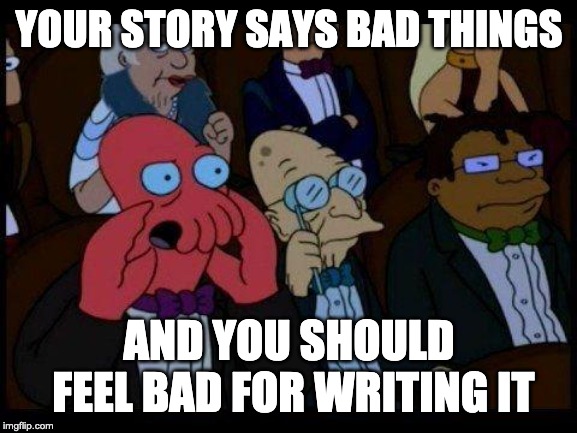
So the title is a provocation, as people are complicated. Nobody is all bad or all good. And most people don’t think of themselves as bad, even if we agree they sorta are, and most people who think they’re bad suffer from mental issues and are no worse than average.
So what am I talking about?
I’m talking about a thing we see in some workshops, the better ones, where people are being honest, but it may be manifested as an author never selling a single thing for years and years and years or forever.
Did that catch your attention?
Your story maker, your subconscious as mediated through your conscious decisions on what to write and how to write it, spits out stories that other people find offensive. Your worldview. Your obviously author-surrogate characters. Your implicit politics. Your anger at the world. Your deep and untreated depression.
There are so many ways to be offensive and, and if you’re a certain kind of person, like me, you will bump into them as you workshop. They are all embarrassing. But they will teach you important things about yourself, and humanity. Things you may wish you didn’t have to learn.
This cosmic embarrassment stage is not optional. You have to go through this, in the same way that a surgeon must get used to people bleeding as they cut into them.
You will endure. Don’t worry. I’ll help you through it.
One Way Your Story Might Piss People Off
Your POV, the interior monolog of your POV character, and or their actions, will be understood as Bad in one of the following ways: uncaring, duplicitous, narcissistic, weak-willed, spineless, cowardly, homicidal, sociopathic, racist, sexist, homophobic, ableist, xenophobic, anti-religious, politically extreme or simply out and out evil.
Here’s the thing. You wrote POV as an author surrogate, by asking yourself, in this horrible situation, what would I do?
Now you’re sitting there, shaking inside, having been revealed to be a bad person. In front of the whole workshop… or in one on one, only to the person giving you this feedback.
What You should do In this situation
Nod knowingly as your POV is torn to shreds, as if this was your intention all along. Do not let on that POV is doing what you would do in that situation. This will help you not hyperventilate, pass out and urinate in your trousers.
If you are able, probe for details, for the reasoning behind the emotional response of others, but don’t defend POV.
Don’t get defensive,
Because you are not your characters. Say it under your breath as your heartbeat slows to normal.
Even when you think you are making your characters do what you would do in that imaginary situation. Take a deep breath. Get through the session. Your subconscious will process this later. Believe me. It will.
If you are writing non-fiction disguised as fiction about genuine trauma and what you did in that situation, and reader responses are tearing you up… look you should see a professional about that.
Most Offense is about Expectations. Genre Expectations. And Generational Expectations.
What you may have just learned is that the genre or generational expectations of your readers are different than yours. Your horrible character might work in horror, or in literary fiction, and might work as a villain in epic fantasy, as the beginning point of some deeply flawed character, but will just be roundly despised by everyone in Science Fiction, which is currently kinda obsessed with deeply likable characters.
You character might read perfectly for people who were reading twenty years ago… maybe most of what you read was twenty years ago?
Yeah. You gotta work on that, unless you can find a time machine to publish your work. Or unless you’re Great. I highly recommend being Great if you can swing that.
How will I learn to stop offending people?
Listen to people who read your stories.
This is a line that’s easy to gloss over, and it’s so basic, and so dumb, and so, ‘duh,’ that if I don’t add this paragraph and jump up and down, you will forget this, and I won’t have helped you. Sure, this is the Scarecrow’s diploma, you waded through all the above, and I hand you this thing you sorta already had, but this goes beyond writing, beyond politics, beyond your creative truth.
Listen to people. If you don’t have friends who are like your characters, seek them out. I’m not going to dig into the diversity reader thing here in this column, on how to do that, this is my general advice that applies regardless of your politics.
I am not saying that other people get to tell you what to think, or what to write. I am talking about your experience of offending people, your sense that offending people might be hurting your career, and what you can do about that.
If you want to emote about snowflakes and kids these days and your anger at stuff you loved getting cancelled by the kids these days, feel free to do that, in the privacy of your own thoughts, or on your blog. I’ll delete your comments here and block you. This isn’t about that.
You are pointedly missing my point.
Listen to what other people say about your stories, not necessarily the prescriptions and the ways they want to change them, those may not work. They often don’t.
Just listen to how your stories make other people feel.
How did you want people to feel, reading it?
Why didn’t it work?
And never, ever, tell someone what they should feel about something you wrote. It doesn’t matter if you put something on the page they seem to be ignoring. They feel how they feel. Yes, I have reached the tautology stage of this argument, which means we’re getting to the end.
If it was never your intention to be offensive, and if you have roughly standard brain wiring, your subconscious will hear these people and will adjust itself in time. Your new stuff will eventually not offend in a career killing manner. Even if you want to find an edgy edge to edge-lord over. In fact, this is how you find that edge.
What if I want to offend people?
Be my guest. A ton of great art is offensive as fuck. To figure out if you are Great, you have to search the space with your writing, which means writing a lot of stories and novels and sending them to a lot of people. If you are even a little great, this will generate useful feedback. Your offensive thing may be pure genius. Somewhere in all that feedback, in that emerging consensus, your subconscious will crack the code, the world will bow down before you, and you will ascend to literary stardom.
Don’t feel bad. Yes your story made some people feel bad. Unless you’re the guy in the paragraph above, that wasn’t your intent. And even if you are, there are no bad people. There are only people who make mistakes, and sometimes do bad things.
Your story never means you’re a bad person. Even if people think it does.
Because you’re always learning. Listening. Growing.
If you’re not… I feel sorry for you.
Good luck with that.
If you found this essay inspirational, interesting, amusing, whatever, join my mailing list. I mean, if you want to. I can’t make you. But I’m asking. Because you read this, and that means I sorta love you. Um. Okay, this got awkward. Boundaries! This is the link to my mail chimp page.
Setting goals is one of those human potential, secrets of successful people, business best practices that the artist inside us distrusts instinctively.
A rigid goal might subvert a process!
A goal might obscure the forrest for the trees!
Nowadays though, as working writers share their lives in detail, word counts, workflows, goals are all around us. Nanowrimo demystified the ‘pumping out a shitty first draft’ thing. Writers of my generation may have imagined a golden creative life that didn’t include nine-to-five agony, production schedules, meetings, outlines, external inputs. Writers blissfully pecking out masterpieces lashed only by beneficent muses… Ah. The dream!
The reality is now more visible.
So, tabling the dream of taking a month break from you day job to bang out a bestseller that makes you rich, what goals are left?
TL;DR. Live. Read. Research. Write. Get feedback. Edit. Submit. Repeat.
Every bit of writing advice you’ll ever get boils down eight things. (if we throw learning into living or researching. Heck. Maybe it’s nine things.) Do all those things and you’ll probably get wherever you are meant to go.
Bye now. Drive safely!
But if the devil is in the details, when does one attempt to do something like getting into SFWA, the Science Fiction Writers of America, or any other professional writers group with a difficult entry requirement?
Typically, this is after one has written a bunch of stories, gotten feedback, submitted a few to many places, maybe had a little interest, maybe sold one or two to non-professional markets.
All of a sudden you are looking for goals. Milestones.
What good is SFWA as a goal?
So I googled some generic business person goal self-help and read a ton of them. I translated them into SFWA specific thinking, but before we get to that we will answer an even more basic question.
If your immediate and unambiguous answers are negative, you don’t like the work in these markets and you don’t want to be in them don’t focus on SFWA as a goal.
You can still submit to these places. The great thing about SF is that as consolation for that no simultaneous submissions rule of most major markets, SF doesn’t do reading fees.
Submissions cost you nothing but the response time.
Maybe you are a part of this scene, and you can’t see it. Never count yourself out. Knock on all the doors. But if you don’t read and don’t like what’s being published and collected today, don’t waste time and energy beating yourself up about not selling to these places. It may not happen.
This doesn’t mean you aren’t a real writer.
If you are naturally a long form writer, concentrate on novels, for trad or indy. Most short indy sells badly, so just write novels if they’re in you; if you are attending Short Story University, consider working in a single consistent universe so that the shorts might find an audience after your novels in that universe start selling. (Again, you don’t have to take my word for anything. Try selling your own indy short spec pic if you want. Amazon doesn’t charge for publishing, but ancillary costs, cover and copyedit and formatting can cost plenty, and the charges pile up high for every title.)
Advantages of setting SFWA as a goal include.
Clearer Focus: The nebulous goal of ‘becoming a real writer,’ or ‘becoming a pro’ can now be turned into concrete activities with their own logic, workflow, and timelines.
Time Management: Having committed to the goal, the more time you put in the better, obviously, but other time issues include submission strategies, the response times of varying markets, coping with the genre’s prohibition of simultaneous submissions, creating strategies for dealing with slow and moribund markets, etc.
Peace of Mind: Having decided SFWA is a goal, and you’ll be doing the reading, research and work involved resolves some of the existential questions about your writing. Like, should I give my stuff away for free on Wattpad, or the web or at Amazon? No, that won’t get me into SFWA. Should I submit my story first to a new market that says it pays well? No. Wait on that. You can try them eventually with stories that have been passed on the markets that will get you into SFWA. That new market may be certified…. Keep an eye on it. Read the first issues. See if its a place you want your work to appear. SFWA isn’t everything, you may still want to submit there immediately. But be mindful of this choices impact on the goal.
Clarity: See above. You are accepting that the SFWA community is doing work you think is worth doing, work you want to do, work you want to be a part of. You are particularizing your love of writing, and your love of Spec Fic as it is currently being written today. Focusing the activity toward this goal.
Straightforward Metrics: As your stories are accepted, or your indypubbed book is selling, you approach your goal in discrete measurable steps. With a single sale, you can gain access to SFWA as an associate member, and while you cannot vote on the Nebula, you will gain access to the private SFWA forums. Getting into SFWA as a voting member subsumes this intermediate goal.
Freedom from Doubt: Should I quit spec fit and write horror? Mainstream? You know I could just write novels. I should just write novels. Wait. Am I good enough yet? I don’t know. Oh, I want to join SFWA. I’m halfway there. I can include SFWA and shorts in my long term plan even as I work on novels, too…
Community Goal Support. (referred to in some business person lists as ‘ease of communication.’) Goal established, patch into networks of people who share the goal. This group will gather and share information about themed anthologies coming down the pike that are open to all, or closed anthologies that are open to people you may come to know, people who may invite you in, or tell you who to ask for a pass. People who will share their data points, about editors likes and dislikes, response times and strategies. Duotrope and Submission grinder makes some of this less vital than it once was, but there’s still no substitute for the word straight from the folks in the trenches.
So, that’s the pre-amble, the prequel trilogy / Triplanetary to my Getting Into SFWA series. Next: Finding Markets, Submissions Strategies, and Weathering the Storm.
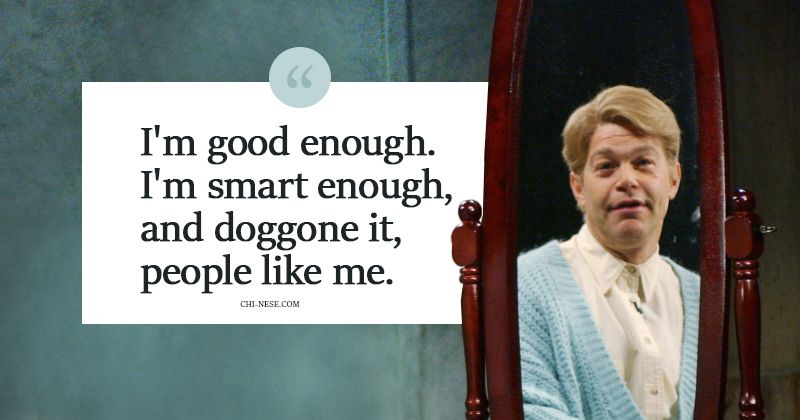
I feel like Stuart Smalley writing this piece. You should probably read it anyway.
When I was working on my psych degree at Syracuse University a long damn time ago, my abnormal psych professor told us about the diathesis-stress model of mental illness in the then-new DSMIII, diagnostic and statistical manual.
Basically, diathesis-stress posits some innate inner quality that predisposes you for some mental illness, but stress is what triggers the illness. Common sense, but if you read the link above, you see that once you pile enough observation on top of common sense you’ll reach non-intuitive insights.
Stress can be bad things happening to you. Stress can also be brought on by purely voluntary attempts at doing hard and traumatic things. Imagine a firefighter, who has chosen her profession, but who must, every day, gear up and send herself into the fire. Let’s say she’s never injured, physically. Oh, but she sees some shit. And she knows… she knows what might happen.
That’s stress.
Now, I don’t want to overstate this… but getting published and making money as a writer, any kind of writer, is hard. Very hard. Super duper hard. It’s stressful.
Writing can be as stressful a thing as the depth of your passion for it.
The more you want it, the harder you push, the more stress you experience. God I know this is simple, but I’m only getting this thirty years in, so indulge me.
The harder you push, the greater the stress.
I was in a crisis, when I went to Clarion twenty years ago, because I wasn’t getting the reception I wanted for a group of stories. Whether or not I eventually published these stories professionally isn’t the issue. (Brag. I did.) The thing is, I had let my identity as a writer slip past my recognition as a writer and I existed in a world of pain and cognitive dissonance. I became embittered.
One of my instructors confessed that she had only considered writing as a career as the world nodded her on, with publication and awards. She hadn’t gotten out ahead of herself the way I had. This of course, made me feel much worse.
Deep in CBT, cognitive behavioral therapy, I hit on an idea that is again, commonplace, but which I have internally sneered at. The idea that your self esteem is, or should be, contingent on nothing.
You see this in memes, about your self worth not being dependent on something. I always rolled my eyes at these memes. So. Hitler should have self-esteem? Me when I am doing nothing should experience self esteem? What a sociopathic joke.
So here’s the thing, and it knits together Christianity, Buddhism and CBT.
If you tie your self-esteem to anything, work or family or friends the state of the world, you are setting yourself up for disaster. If your work is the source of your self-esteem, then you will suffer, because no matter where you go, you’re failing to be the person the next rung up the ladder. For me this has meant, so far:
I hate myself because I never finish anything.
I hate myself because what I finish is crap.
I hate myself because the thing I thought was good was called crap by my whole workshop.
I hate myself because this thing I wrote was hated by that one guy in the workshop who hates everything. Because none of us are publishing much, I think he is right.
I hate myself because something that my workshop liked was called crap by a pro.
I hate myself because the thing a pro agreed was good was rejected by an editor.
I hate myself because something that me, my workshop, and my pro friend, all agreed was good, was rejected by all the editors we collectively care about.
I hate myself because even though I publish 10% of what I finish and submit, it takes years to find places to publish stories, and I don’t make much money doing this, and only selling 10% means I make, literally, a tenth of a cent per hour. (see how the goalposts moved suddenly?)
I hate myself because my published work–I now sell half of what I write–is never nominated for anything or anthologized or honorably mentioned in the back of the one big antho that everybody has read forever.
I hate myself because now that I get mentioned in the back I never get inside. Oh, I did get into one best of. But not that other one that’s older.
I hate myself because people who started publishing when I did now have successful novels and TV options, and I didn’t write a novel when they did. They did it. Why didn’t I?
So this is how far I got in this; at every step presume that I have achieved every goal beneath it.
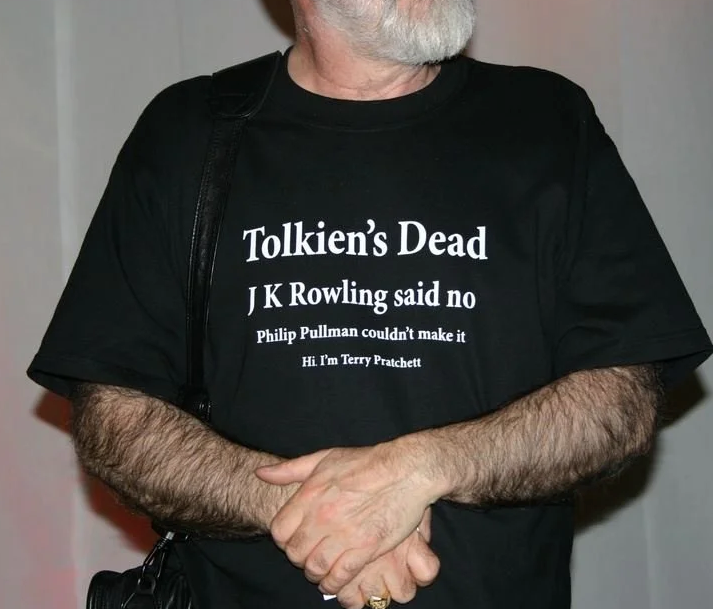
Let’s talk about how this relates to Terry Pratchett. Here’s his Wikipedia brag paragraph.
The text reads, Tolkien’s Dead, J.K Rowling said no. Phillip Pullman couldn’t make it. Hi, I’m Terry Pratchett.
Look at the bio. Then look at the self-deprecating t-shirt. I’m not saying that Pratchett was consumed with self loathing. I am saying that if you make your self worth, your happiness, contingent on ANYTHING WRITING RELATED you will live in a world of pain. I have lived in a world of pain, off and on, in every creative endeavor, and I have spent my most of my life on creative endeavors, artistic, literary, hackery, entrepreneurial.
Talk to me, read me, and I’ll urge you to keep writing; I’ll share inspiration and stories of eventual ‘success’ (there! I’m doing it!) but you have to know that success never makes you happy. Remember Curt Cobain? And a billion other beloved suicidal geniuses?
My clarion instructor told me, that in the end, the world’s opinion on your work is only a greek chorus. And that is exactly what it should be. It’s okay for your goal to be becoming a great writer, or becoming a critically acclaimed author, or becoming a popular author, or becoming all three at once, even thought that almost never happens, just read the goddamn shirt, goals are okay, but if you are telling me that your happiness, or worse, your continued existence on this planet is contingent on some specific success in some to you reasonable time frame, I need to direct you to seek solace elsewhere.
I would never say ‘seek professional help’ because nothing makes anyone avoid professionals as much as this suggestion, but I’ll tell you that I did seek professional help and it got me out of this bind. Several times in my life.
We can support each other as writers, and accidentally enable this untenable thing, this mentality, as a family member might kindly enable a substance addiction.
So, if a pro tells me that every voice outside of the one in my head is a kind of greek chorus, I am allowed to define success however I want. Wait.
I am allowed to define my success however I want. I don’t need a professional’s opinion.
Oh, and you know why Christianity, and CBT, and Buddhism all have this idea, that the chattering nattering voice inside you whispering terrible things about your work ethic, your lack of talent, must be minimized? Washed away in the blood of forgiveness after repentance, or sometimes silenced with focus on the breath, or spoken back to with the calm and rational voice you might use for a friend?
Because it works. Shame and blame and punishment and self loathing and mental illness don’t help you become a better person. Or a better writer. This isn’t a moral observation. This is raw practicality, the birthright of successful and canny sociopaths, and the insight of great religions and the gold standard for secular insight-based therapy, all wrapped up into one package.
This is how you get shit done.
You will do whatever it is you are trying to do if you stop wasting your energy wallowing in unhappy, negative, counter-productive thought. Whether it’s being a better person, being a better writer, or selling what you write.
Or all three at once.
If you found this essay inspirational, interesting, amusing, whatever, join my mailing list. I mean, if you want to. I can’t make you. But I’m asking. Because you read this, and that means I sorta love you. Um. Okay, this got awkward. Boundaries! This is the link to my mail chimp page.
There are two kinds of people. Those who are writing, and those who aren’t.
The ones writing are writers. The ones who aren’t, aren’t… at the moment.
Many folks not writing at the moment don’t feel bad, though. They could start writing again at any time! They plan to! They know they will!
Professionals, people who make a living, kinda know they will write again, pretty soon, to avoid starvation. So. They have that going for them.
Wait. Is that good?
I have a friend who is a big-five horror novelist, teacher, writer, and all around great guy. He advocates never quitting your dayjob. Of never having to write something you don’t want to write, for money. Because that happens. A lot, for the non-rock star pro writing class, ie, most of us. He has been working on his second novel, for some time now. I think he has 1000 index cards. It will be great. It takes as long as it takes.
That’s one way to do this.
I have another friend who publishes between two hundred fifty thousand and a million words a year, which is basically a short story you might read in twenty to forty minutes every single day of the year. Of course she doesn’t write short stories, but novels in the 30-60k count, in series, in a few romance sub-genres. What is that? 10? 15? I’ve stopped doing the math on her.
They’re both writers.
I have friends who have never published, who have written for years. Some have unique perspectives and are having a hard time finding publishers because of this. They’re writers.
On indypub forums I have read the stories and explored the work habits of a new generation of pulp writers, working in many genres but often romance, as romance is more than half of all fiction sold. People who have escaped day jobs… at Walmart. In other big box stores. In food service. Office temping. House cleaning. People in places with little opportunity. Making a penny a word works, for them, a hundred bucks a day, to start, working 8 hour days a day in the mines, then an 8 hour day writing, the sleeping a few hours, every day. Once they have strong back catalogs, they reach the point where they go full time.
They’re writers too.
Try to let go of Writer as Identity. Embrace Writing as action, as the act of writing, as the act of research, editing, plotting, outlining, however you do it. It’s okay, to see your life as material; it’s okay, not write, too, it’s okay to call yourself a writer, and never write. But. That feels sad to me. I think part of the word aspiring is that. Often. People who don’t let themselves think of themselves as Writers and thus, who never feel they are truly writing. For some, the identity must precede the action. So the action is delayed and diminished and never fully begun.
What I’m really saying, to the aspiring writer is that by writing you arrive. The blank page waiting before you is the exact same page that has confronted every writer since the begining of time. Every writer you have ever read sits beside you, at computers, holding notebooks, at battered typewriters, holding quils, manuscripts stuffed into pockets on battlefields, holding ball point pens in shitty diners, at tiny desks in sheds, dictating into phones, standing in line daydreaming with focus, packed into subway cars, lounging in palatial hotel suites, living in trailers, in mansions, in rented rooms, in cardboard boxes.
When you write you’re a writer. So stop aspiring and sit down and write something.
It doesn’t have to be good, for you to make it better. It doesn’t have to be good, to learn something from the act of writing it. It doesn’t have to be published, to have been worth writing.
Let yourself do this. You aspired. That’s the first part. The next part is easy. If you let yourself. If you let go of expectation, of ego, of identity, of fear, of jealousy.
Let go. Write. Read. Live. Lather. Rinse. Repeat.
Whatever your destination, every step brings you closer, every word appearing on the page. Like this word. And this one. And so on. Write with me.
You are a writer.
So write.
If you found this essay inspirational, interesting, amusing, whatever, join my mailing list. I mean, if you want to. I can’t make you. But I’m asking. Because you read this, and that means I sorta love you. Um. Okay, this got awkward. This is the link to my mail chimp page.
After invoking the ‘10,000 hours to mastery’ thing a few times, a friend has pointed out, with characteristic grandmotherly kindness, that Malcom Gladwell’s idea is, in a word, non-scientific. Or rather, wrong.
Or you could say, total bullshit.
One very good reason for this is that Gladwell isn’t a scientist; he’s a popularizer who summarizes scientific thought. This in his own words:
“I am a story-teller, and I look to academic research … for ways of augmenting story-telling. The reason I don’t do things their way is because their way has a cost: it makes their writing inaccessible. If you are someone who has as their goal … to reach a lay audience … you can’t do it their way.”
Critiques of Gladwell’s idea that 10,000 hours turns anyone into a pro are easy to find on the web now, though they are a bit harder to find than positive reviews of his work. Gladwell responded to this criticism by saying: “No one succeeds at a high level without innate talent.”
Which makes you wonder… where the hell did that 10,000 number come from in the first place, if not a close read of the actual science?
The answer contains a sliver of hope for those toiling away at stuff for what feels like a long time.
Looking at great classical musicians, you see people who practice. A lot. The kind of practice that the 10,000 hours suggest makes someone great. However, a recent study has found that practice accounts for only 20% of the success of these musicians. Leaving something else to explain the other 80%.
Some call this thing talent. But who knows? It could be beneficent angels or aliens. Whatever. What science doesn’t know, science doesn’t know, and that’s the point in being careful about Gladwell, and in fact, most popularizers of science. Sometimes telling a good story means playing with the facts.
So where did that idea come from? That time invested equals mastery?
People often work hard at things they are good at, and I say this like Gladwell, based on anecdotes, life experiences, and intuition. It seems often to be true.
People who are good at things often seem to work like crazy on them.
So. If you find yourself wondering about that 10,000 number, and trying, and failing to figure out how the hell you even count hours, to become a writer, when every single second of experience can be thought of as content if not practice, you can take comfort in the unscientific idea that your sticking with writing puts you alongside people who do succeed.
But this doesn’t mean you will succeed at the highest level automatically, without (mystery ingredient X, which I still refuse to call Talent. Let’s call it The Practice Multiplier. No. Let’s just call it ingredient X. That is more fun.)
Bottom line, which is why I think ingredient X and its lack shouldn’t stop you: Writing is Good. Writing is good for you, for me, for people who never publish a word, for people who sell a few poems or stories, for bestselling authors, and everyone and everything in between.
Writing is mindful. Writing is a kind of meditation. Writing reveals what you love. Writing reveals you to others. Writing is catharsis. Writing creates empathy. Writing is therapy. Writing won’t bankrupt you unless you do it all the time and make no money and insist the world owes you a living for it. (don’t do that.) Writing creates little in the way of greenhouse gas. Writing makes books which for many people are one of the main reasons to go on living. Books make culture. Culture makes humanity.
I will, with a clean conscience, advise writers to keep writing, for as long as they find it meaningful. If they are very sad, about their writing, about its reception, and find no joy it, I’ll agree they should stop, but not without suggesting they first attack that sadness head on, to see if something else is the cause. Though quitting for a while is fine.
I quit for 18 years. That was a mistake.
Did I write for 10,000 hours overall, in my first try, before I gave up? Maybe. Am I a professional now? According to SFWA I am. My few dozen sales might make me look professional to some. I’m gonna say I write at a professional level, though I do not make a living at it. Some days I add the word Yet, to that sentence, and other days I think, “oh. I must lack ingredient X. I am doomed.”



 After invoking the ‘10,000 hours to mastery’ thing a few times, a friend has pointed out, with characteristic grandmotherly kindness, that Malcom Gladwell’s idea is, in a word, non-scientific. Or rather, wrong.