Digital Minimalization Day 7 of 30: When I Cut My Hair.

For the last six months I have been paying for subscriptions to both DC Infinite and Marvel Unlimited, which I scrutinize as I cast about for subscriptions to cut, in Grown-Up Mode, attacking various checklists. So of course, rather than actually cancel one or both (why did I think I needed two?) I decided to use them.

Wait, you didn’t come here for this; what is Day 7: Echoing Emptiness?

It’s the hollowness, the cathedral like stillness of my internal theater, when I clear out several daily hours of human connection–and conversation, as I step away from social media.

I grab my phone and reflexively flick and tic my way through the apps I’m allowing myself to check. I check my e-bookstore dashboards to see if I’ve sold books. I have, I sold a few for six dollars. The dopamine pop fans an ember in my brain that creams out for more fuel. No more sales, at the other services, Amazon, Barnes and Noble, Kobo, Apple Itunes, Smashwords, Google play… one after the other.

I’ll look at them again a few more times today.

I check my mail; my blog comments are hooked to my mail. So I can see I have none. So I’m not here to read, I’m here to write, which at least, is something. Conversational typing more in composition mode, but then, my FB essays were the same damn thing. I’m just a heroin addict on methadone.

Drama queen metaphor aside, my brain is writhing.

(Here I drift into memoire. TL;DR, cut loose from social media connections, the steady diet of dozens or hundreds of likes, and shares a day, I reel backward into the past.)

So I’m reading a few comic books, a few short stories, and listening to books, in and around the wizened nub of my freelance career. I wanna put quotes around that. Every time I try to use the word career I am struggling to avoid the air quotes.

I read the first four books of Flashpoint and marveled, (Hah hah, I DCed, really) at the degree to which comic book prose tolerates expository dialog. Flashpoint is a completely novel world, which has to be unloaded as a little staged action and a ton of maid and butler dialog; a ton of exposition.

Enjoyable. But I remember that kid in the seventies who ached for long comic book continuities, but could not achieve them. I collected comics for a few years, but was bad at getting to conventions or stores and so the comic book shared universes were these things I uncovered in bits and pieces like an archeologist, full of mysteries, omissions, holes. You had to intuit the shape of the bigger pictures.

It was frustrating and glorious. Going out into the world, looking for the missing puzzle pieces. The used bookstore. The rack at the drug store down the street from my elementary school on a hot day, the last of AC as I enter the store, spinning the rack, and finding the latest issue, without a gap, the number is sequential with what I was reading because distribution was so shitty that you could miss an issue.

I’m listening to a Spotify track as I take a shower, a playlist, early 70s, music made when I was seven, that I took deadly seriously at seventeen. Unironically. My kids regard anything older than five or six years as a quaint if adorable object. A reminder of youth. Hopelessly out of date.

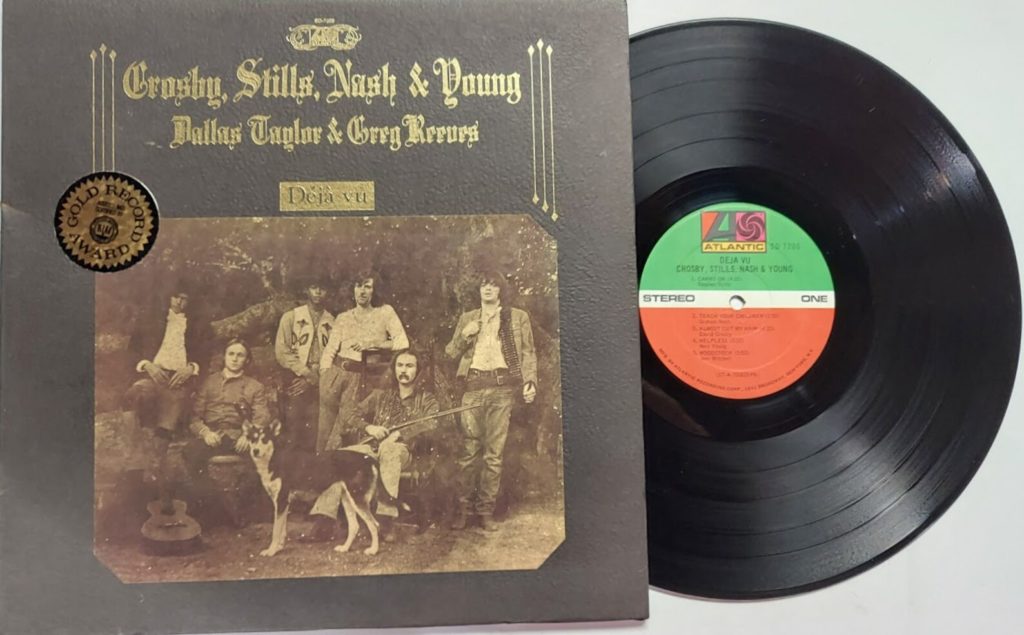
Deja Vu, Almost Cut My Hair, recorded in a single take shortly after David Crosby’s girlfriend dies in a car wreck, was never a goofy charming thing. The thing to which Crosby feels he owes something, rebellion, bohemia, the antiwar effort, everything, was vividly alive in us, as an aspirational goal as that naive youthful idealism died, as I grew into an age to fully understand it.

I grew out my hair… but my mom kept bugging me to cut it, and I would because it was the end of the 70s and the Viet Nam war was ending and I liked my mother, so what the fuck. Path of least resistance. I was half-assed even at my own rebellion. Partially because my hair grew into this curvaceous, stupid-looking blow dried helmet, and I kept hoping that if it grew long enough, it would morph into Jimmy Page Led Zeppline mane….

But by the time I got out of my house, away from my mother, away from my dying home town, my black hair was receding badly, a Riff-Raff pony tail down the back, and shaving my head was a relief.

When I cut my hair I was writing derivative cyberpunk fiction. I was living in a real city. I was getting ready to get married and have kids. I was embarking on my graphic arts ‘career,’ and writing. My comic book collection was at home, the home now long gone, in a cardboard box.

And my mother died the first of this year. All that’s left of those homes I grew up in, the one they retired to for 23 years, is a glass case with a scattering of mementos. My father’s hip joint culled from his ashes. A necklace of my mothers. (Her rings all vanished shortly after she died.) Some little glass birds, that were her mothers.

And as I clear out the clutter of social media, instead of plunging ahead into my burgeoning, hah, writing career, instead I’m a nine year old walking, along, as we were allowed to, a mile to the drug store. Listening to a transistor radio. Bye, bye, Miss American Pie.

I go now for a walk in the 90 degree Delta COVID hothouse as the latest useless war devolves into it’s Saigon moment. I remember the original, of course.

It had a better soundtrack.

I’ll listen to that radio, that same radio, over the magic Uhura bluetooth headset yolked to my communicator linked to the global computer network, and then I’ll slog sweatily back home and read a comic from that year on my magic slate, a slick digital pad, glowing with hues so much more saturated, linework razorlike, sharper and cleaner, than the coarse screened four color ink of the original, flimsy, double stapled fragile paper things.

I want to tell you they cost twenty five cents, four for a dollar, like some WW2 vet blathering about how much boloney he could buy for a nickel during the great depression…

Aww, fuck, I got to a 1000 words. Sorry.

The past is flowing into my mental void, bottom line.

This wasn’t my intent.

Digital Minimalization: Day 6 of 30 Connection vs Conversation

Digital minimalism makes a distinction between connection and conversation that is used to determine what tech tools to use, and how to use them.

Newport borrows this idea from another text–his book is basically the synthesis of a half dozen others he cites plus his reactions to them. I should go dig it up for you but I’m lazy and I want to get in and out of this post fast, for obvious reasons; just be aware, that Digital Minimalism isn’t a Newport invention; it is an amalgam of six other books, plus Newport’s last book, with an extra dollop of opprobrium directed at the tech giants for behaving like tobacco companies thrown on top.

Oh, and his case studies, garnered through his platform, a self selected group of folks he puts through a few experiments, and some other successful people who have shared their stories.

Anyway, social media likes, shares, follows, are connections.

Conversations are one on one, phone, video conference, or in person, with the last being best, the first the worst. The high-bandwidth, real time communication between individuals is supposedly the source of human empathy, the learned component, the training ground, with a few studies mentioned. Conversation is what we crave. What we really need.

Connection, is a poke, nudge, wink, smile, heart, like, follow, mass email, one to many posting, a tweet, whatever.

Connections are okay, but when they displace conversation? Yeah. It’s the corn syrup idea I mentioned in a previous post.

I can’t remember if I’ve said this yet or not, but again, here goes, but the act of doing a one-to-many conversation yourself, spewing something into the world, to a lot of people, and getting feedback, actually feels good and in social media friendly studies seems to be a Good Thing,.

The problem is the one-to-many from the other side; imbibing a ton of the one-to-many posts, reading a ton of other people sharing or venting or bragging? That is NOT correlated to happiness.

This causes FOMO, this is a feeling of inadequacy, the sense that others are having more fun than you, leading more fulfilling or meaningful lives. This is a kind of vicarious living that isn’t really being alive. It used to be you could only get so much of this stuff, a columnist or two or ten. A celebrity life column, People magazine.

Twenty million oversharing quirky quasi columnists of every possible political and social and racial and sexual make-up?

That’s a firehouse of corn syrup. That’s an endless IV drip of comforting noise that leaves you empty and depleted.

This is the the thing I take away today. Sure, I could get a few hundred folks engaging with my social media content. They’d enjoy it. But maybe they have better things to do. If I want them to read books? Leave them alone. Even if they don’t read my books. If all of us writers did this? I’d get more readers too.

You’ll see big name folks who basically post in their feeds and react only to the stuff in their feeds. They don’t have to shop around for interaction. Social media is a bottomless pit of folks chatting them up. With a button that ejects the assholes.

The only way this damages the big name is she is distracted from work; she’s not getting FOMO, she doesn’t feel invalidated, her life is a source of endless fascination and conversation, her work, her opinions. The toxicity is vastly reduced.

The downside?

I am thinking of a beloved author I know who writes, conservatively, 2-3k of social media, Facebook–a day. It is exquisite. It feels _copyedited_. This writer grew up on typewriters. The text is clean, the voice is perfect, effortless, the prose is interesting, the viewpoint is engaging and intelligent, and the topics are topical, up to the second reactions to the news of the world.

Readers have been awaiting the next book in one of the writer’s series since the early 90s.

Converting the social media output into fiction would produce the book in two months.

Let’s say there’s a big research component. Four months? Six?

Anyway. I love this guy. His life and his work is his own, and I have no right to complain. I bring him up as the example, of someone getting as much as they possibly can out of social media… and the perhaps unintended consequence of this enjoyable diversion.

And the time it eats. The words it devours. The eyeballs it catches.

The life that rushes by.

When Family and Friends Won’t Read You

Maybe they belittle your writing. Remind you it’s just a hobby. Ask if you’ve been published and then how much that paid. Remind you not to quit your day job. Or they dismiss your genre completely. It isn’t literature.

Or they pay lip service, provide generalized support…

…but never actually read you. Or if they do? They don’t mention it.

And of course, they never write reviews.

Yeah. That’s a thing. My wife and kids and most of my pre-writing friends don’t read my work. In the 90s I used to flog them with it, as I sold to semi-pro markets. Even the wife, kid, and friends who are SF readers never read me. And my wife reads several hours of genre fiction a day.

She could get through my published work in three weeks. 

Ouch. Oh, and the amazing thing is, you can actually blog this, and not worry about it, because they’ll never notice, because they don’t read the blog either.

Maniacal laughter. Sullen staring. Rubbing of the temples.

It’s tough. You rely on these people to some degree for emotional support, or financial support, your whole life, and then, when it comes time to validate the time you have poured into this… they can’t put in a few hours of effort to inspect the output.

Why?

Who knows.

Look. It’s weird. Believing in someones prose, anyone’s prose, is a kind of hard work. Entering that willing suspension of disbelief. Losing yourself in someone else’s story. Your friends and family carry all this baggage about you, your strengths, your failings, your blind spots, and as they read your work, sometimes, this memory of you stands on their shoulder, this grinning homunculus poking them in the face. Who is this character supposed to be? Who is this romantic interest? Oh gross, my Dad is thinking about sex?

You get the idea.

Of course, some friends or family will read what you’ve written, and tell you what’s wrong with it. How to fix it. That’s hard to deal with too. Are they writing and publishing in the places you do? No. But they can tell you why your work isn’t working. For them.

So what is the answer?

Let this go. It doesn’t matter. You’re being a drama queen. This is life, dude. Yeah, other people’s wives, kids, family, friends read their stuff and LOVE it…. yeah. You’re not them. Deal with it. Move on.

If they aren’t editors, if they aren’t agents, they’re just a few random people you happen to know. With random opinions. Sure, they’re your people. But they aren’t your readers, and they will probably never be. You don’t work for them.

Someday some of them may get on board. Probably not. I thought, if I started publishing a lot in bigger magazines….

Nope!

But I like to think after I’m gone, when my kids are longing to hear my voice, that they can pick up some of what I write, and read it, and smile, and hear me again.

Why not? It’s a harmless thing to imagine.That we win in the end. After we’re gone. The payoff. It’s the ultimate existential loophole of the artist. I’m fucking Van Gogh who sold two paintings and some drawings in his life. Prove I’m not.

You can’t.

It’s a cheat. But use it. What we’re doing is hard. You can’t let the opinions of random people get you down. Slow you down. Shut you down. Or stop you.

Even when you love them.

Digital Minimalization: Day 2 of 30

So, we’ll call yesterday day one, as I finally got around to deleting the social media apps from my phone, one of my long-term goals is to not check social media on the phone… hey, let’s throw down a disorganized list of crap I’ve been ruminating on based on the book.

Minimalist Goals

  • No social media apps on phone DONE!
  • Social media Saturdays only (for after the 30 day fast, we’ll see if that makes sense)
  • Daily blog posts 500 words or under (this is my conversational typing; skipping the blog and writing one on one emails is probably better. I need conversational typing. It’s like warming up for me.)
  • Half hour walk without phone daily (phone in backpack in a zipped bag) I walk an hour or two a day. Dedicated some of that time to silent walking, no books, no possible interruption, seems like a good goal. I do it fairly often, just shut off the audio feed, but sometimes I talk to friends instead, which for me, is a dangerous activity. I can talk to friends for fucking hours.
  • Turn off notifications, disable that cruft of marketing emails that grow like weeds in the inbox, one by one as they pop up, unless they seem VERY useful. IN PROGRESS.
  • Unsubscribe from underused paid services (IN PROGRESS xbox live went yesterday) Not really digital minimalism, but an adjacent idea that Newport cites without naming it’s souce, the Your Money or Your Life movement.
  • Cut streaming channels that are under-used (IN PROGRESS Acorn went, but kept BritBox; maybe Shout goes next, but I keep the Rifftrax friends channel)
  • Read a print book or kindle or comics on the iPad once a day. ( so far, so good. I read a new issue of Wonder Woman, which was good enough to make me cry. Very much in the vein of Neil Gaiman, it seemed to me, who I love.)
  • Shut off all notifications on iPad.
  • Listen to ALBUMS on Spotify. As a kid, it was understood that listening to  singles was a juvenile activity. My school-age brother and I listened to the vinyl Beatles albums my parents bought, lifting up the needle to avoid George. Harrisons weird ass sitar music. I would eventually love the whole Beatle cannon, but as a kid a single off putting song had to be stopped. Immediately. As a teen I realized that the songs I liked on an album often taught me to like others, and even if I liked some more than others, that was Okay, albums were supposed to be like that, songs that drifted to the back of your attention, and songs that smacked you in the face.
  • Subscribe to the NYT news I want to read as email. Make those emails the whole written news ration.
  • Set up a RSS Feed reader with aspirational reading to satisfy the urge to poke around at links
  • Unsubscribe from Washington Post (Trump is gone. We helped save journalism. Now just the NYT will do. Yes, I know the NYT isn’t perfect.)
  • IMPORTANT: Log the joyless ticks that fill the spaces left by removing these things, the fresh weeds cropping up, because my distraction problem lies deeper than any technology. I delight in the erasure of my own consciousness. I demand immersive narrative, or a perfect work flow state; almost anything between is excruciating. Also, getting into flow is like getting in freezing water. I avoid doing it with time wasting tics.
  • Meditate daily again, using some of the empty real estate

That’s more than enough to think about for now.

If you have had issues with interruptive technology, let me know what you have done to limit the damage in the comments below. It might be fun to share.

Cal Newport’s Digital Minimalist One Month Brain Wash

So, here I am, I’m doing it.

I’ve been ‘off my feed,’ (hah Hah) for three weeks at Facebook, slowly picking away at Newport’s new book, Digital Minimalism. The full scope of his plan now apparent, I am going to do the full-bore brain reboot until September 26, which will give me seven weeks off FB (my biggest issue) and a month of other interventions which I am still working out.

Newport tells us to classify our use of interruptive technologies into essential and non-essential. Interruptive is my word. CDs are digital but listening to CDs isn’t a problem; same goes with DVDs. Youtube, spotify and Netflix, on the other hand, are digital in the  problematic sense of the word–networked, always available, ie, a feed, with reward mechanisms built in, (likes, shares, and followers.)

Addictive, in other words. The problem is with tech that is addictive.

Were we addicted to vinyl, the radio, broadcast TV, VHS cassettes? Neil Postman said we were in Amusing Ourselves to Death. Now? Watching TV, all together, a family, now seems quaint and healthy, a damn near Little House on the Prairie level of togetherness.

There’s a gen Z (Cap Newport calls them ‘igen’, for ipod and iphone, which is, uh, strange.) meme that derides a clueless boomer blaming the waves of mental llness plaguing young people on smartphones, tossing out other possibilities, including the rise of fascism and the imminent collapse of civilization and mass extinction events around climate change. So you don’t want to be that guy, that out of touch boomer.

But Newport trots this out, that there’s this GIANT spike in mental health issues that corresponds to smart phone usage, and if we take the blame the victim out of the suggestion, if we attribute a lot of this damage to the policies of the tech monopolies which prioritize profits over user sanity, then we can still constructively poke at this idea, look at the research, without being totally dick-ish boomer trash.

Because people do embrace habits and addictive products, that make rich people richer, to their detriment. Tobacco is the classic case in point.

Anyway. Look, I’m an SF guy. I wanted a global computer network a lot lot like the one we now have. I dreamed of it. SF writers have been dreaming it up for three quarters of a century.

Robert Heinlein, (yes, I know you hate him, let me just get this out, because it’s fun) envisioned this wonderfully steampunk kind of wikipedia global library network that consisted of telegraphically linked pneumatic tubes and microfilm.

So you would do your ‘google’ search, which of course, spat out whole books, but still, and a few minutes later, THUNK! A spool of microfilm would arrive in your delivery slot. RAHs steampunk online network morphed into a super-compuserve with fantastically high fees associated with them. In the novel Friday, an agent is giving an _unlimited feed budget_ and discovers amazing things by following her subconscious in areas of seemingly unrelated research; she is awoke in the middle of the night by her superior who asks when the next outbreak of the plague will occur, and without conscious thought she spews out the answer, having run her brain through a lot of this data.

But we all know that wikipedia, by any other name, isn ‘t really the problem with the network. I’m guessing the number of people damaged by wikipedia is similar to the number of people crushed under the weight of their VHS collections.

Not to paraphrase Newport too heavily, but he relates the discovery of a ‘default network’  detected with PET scans during experiments, brain regions that light up as soon as you complete any task.

They put you in the scanner and have you do stuff, math in your head, remember grandma’s pudding, whatever, and when you stop doing that, bingo, back to the default network.

The default network spends its time in rumination on social interactions. IE, when we aren’t thinking about anything else, we are trying to figure out other people, and our relationships to other people. We really are social animals.

This is where the lovecraftian horror of social media clicks in.

Social media gives you a fake, always on, monetizable and thus monetized (Late stage capitalism!)  version of this thing your brain craves 24/7. Likes, shares, and followers are to in person social contact what corn sweetener is to fresh fruits and vegetables.

As we gorge on fresh followers and likes and shares we have a tendency to slowly starve. The corn sweetener lacks nutrients. As with corn sweetener, of course, it is better than nothing. Corn sweetener isn’t poison. Neither is social media.

But it often, maybe usually, displaces something better for you, and this isn’t your fault.

It’s designed to do this.

Thus, the brain reset.

Cut out the non-essential stuff; see how you feel, see what you get done, and then reintroduce the optional stuff, and see if it actually makes you happier.

I’ll keep posting on this I got another month to go.

Ugh.


Social Media: Color Me Gone.

So I read Cal Newport’s Deep Work, some time ago, and enjoyed it. I wrote a blog post about it, as I recall. That ten people read. Or whatever. One of the things Newport didn’t really tackle head-on was the full-bore evil of social media companies which prioritize engagement over the mental health of their users, and over the continued existence of democracy.

Oh, and of course, valuing engagement, clicks, hits, eyeballs, which means MONEY over, say, hundreds of thousands of extra folks dying in agony from the current plague.

So. Right. Facebook and Twitter are both fucking evil. Full stop. It’s not ‘how you use,’ the tools. These things are intrinsically bad for everyone. You can switch to a low tar cigarette by taking the app off your phone or avoiding your feed and using groups and sticking to small circles of friends, but the apps will resist every single thing you do to lessen the amount of time you use them.

They have to. They give you ‘friends’ but they are not your friend.

Social media is compelled by fiduciary responsibility to the shareholder to maximize short term profits, at the expense of their users time, sanity, privacy, their employees quality of life, public health, democracy, because that’s how capitalism works now, and social media, big tech in general, is as capitalistic as capitalism gets.

Move fast, break things. Democracy? Oops. Public health? Eh.

Anyway. Sidetracked there. Breathing heavily. Hey, you know what? That’s the rage I have welling up in me that hasn’t had an outlet, because I’m a few weeks into a FB and twitter fast. Look, I was never sweetness and light. My rage at my species that could create a paradise that instead actively destroys itself and the planet didn’t materialize overnight.

But the sensation, of living in that rage, constantly, of someone or something constantly poking a stick into the festering wound… that’s sorta a post millenium thing.

I responded to this political rage by writing, and sharing what I wrote, and… I was gonna say ‘building community’ around that but who knows what I was really doing. Spreading a disease? I did have folks tell me I was keeping them sane, back during the Bush administration, before Paul Krugman started saying exactly what I was saying with the NYT and a Nobel prize to back it up, as opposed to my BFA from Syracuse University and freelance design career.

I was addicted to writing mass emails that went out to yahoo groups. I had a few thousand readers. We tried to monetize the lists and use the money to work at lobbyists and got pretty much nowhere, netting a few thousand bucks over the eight years which we turned into trips taken to protests where we sold buttons and shirts and jumped up and down and watched our numbers underreported by the MSM. We tried to stop the wars, see, the useless wars that are finally ending now. We failed.

The wars that did nothing to make anyone safer, twenty years of burning billions of dollars and thousands of lives in vast stupid bonfires, to replace the Taliban with the Taliban and transform Saddam into ISIS.

Me and my people knew these wars were worthless. They were built on lies, that we knew they were lies, and we knew this before the first bombs were dropped. We were screaming at the top of their lungs. The best experts agreed–there were no weapons of mass destruction.

And you know–there weren’t.

Sad basoon music. Rage.

Anyway. So we can see that social media, primitive at the time, was this place where I played at politics, where I performed a political identity. Now I have known people that actually worked in politics, at the local, state, and national level, and so I knew in my heart of hearts that I was mostly doing nothing, sitting in a little virtual bar ranting at people to little or no effect.

But… Jesus, it felt like I was doing something. They wanted me to feel like I was doing something. Social media was designed to make me feel like I was doing something. 

Jumping up and down and bellowing at people, who were going to vote for the right people and donate to the right causes anyway, enjoyed my content, but they all read the NYT and WAPO and The Nation and The Atlantic and everything else, you know, stuff written by people who were paid enough to copyedit what they did.

I did a few real things. Showed up at a few protests that mattered. Shut down a right wing radio program. Worked for Liz Warren, on her first campaign. Donated some money here and there to campaigns, wrote some letters, did some call center stuff. That stuff mattered, and matters, and it is so, so, so boring and hard to do.

Going door to door, again,  you are only ever talking to the converted, trying to get a democrat to vote for the democrat, but in this case? Yeah, every now and then you actually make that happen.

Stacy Abrams did this, right? It mattered, what she did, and actually, it wasn’t just her, she was part of a huge huge effort. Of people doing stuff in the real damn world. If these activities had been confined to social media?

I can assure you, it would have come to nothing. Because social media likes things they way they are.

So we can see, for me, social media was part of a political life that began with listening to my father rant and rave about Nixon and watergate, listen to him dictate angry telegrams to the white house, the supreme court. That political life is significant, and it has counted for something, maybe, but every step forward was also a step back as I donated my time, my effort, my voice, my writing, for free, to comically evil techno billionaires.

Facebook elected Trump.

Now in a close election, you can say that about anyone, any small number of votes; the leftists too pure to vote for HRC, the POC unenthused by mass incarceration, that stayed home, the men who didn’t vote for her because she was a woman, the people she didn’t bother to court in the swing states that decided the electoral collage, and on and on, but one thing is certain.

The mis-information created by Russia, pushed through FB, elected Trump and Trump has killed us by the hundreds of thousands.

And every anti-trump FB post I wrote was gluing in eyeballs and generating revenue for a company that shrugged at white supremacy, at best, if it wasn’t an active campaign contributor. This company prioritizes its bottom line over everything else. This is what most companies do all the time, but when that company is an unregulated monopoly?

Yeah. That’s when we get epic tragedies on the scale of Trump.

So, Facebook and Facebook products make up, what, 20-40% of all internet traffic? You can’t get off Facebook if you’re a business, not really; we’re yolked to this thing. I can’t blame anyone for being on FB who has to be there. I’m not judging anybody but myself.

But you know? I don’t have to be on FB. And I blame myself for Trump, a little bit. I fought for HRC at the end, but not hard enough, and not for long enough. I didn’t think Trump could win, and if it hadn’t been for social media… he wouldn’t have. I didn’t know sick we were.

I didn’t realize the way the right-wing disinformation machine had dovetailed with facebook and youtube to sell white supremacy and conspiracy theory. Some science fiction writing, technology loving, naive fool remembered Google’s motto–don’t be evil, remembered the dream of an internet that made us smarter, instead of one that drove us mad and empowered idiots.

Oops.

So. That’s enough for now. That’s why we leave FB. Sure, it’s bad for us, blah blah blah. Ruined attention span and being intentional and whatever, I’ll talk about that later. But the one two punch… bad for you, and bad for everyone else? Bad for the country? Bad for humanity?

Yeah.

I gotta stop being part of this problem. I have to.


Learning to Read Again

I lost the ability to fall into a book, lose myself in fiction, sometime back, decades ago, I guess. Writing, trying to write, being frustrated by rejection, scrutinizing and workshopping my text and the texts of others impaired my ability to just slip into the prose.

So I pushed through it.

I still found books that grabbed me, that tugged me along, that gave me the old feeling I used to get from literally every book I read. But more and more started things and did not finish them. Did not feel drawn to finish them.

And the amount of time I could read, that felt normal to read, slipped to about a chapter. I’d read one, enjoy it, close the book. Ruminate on it. And feel full. Also, perpetually sleep deprived, I’d relax while reading, and pass out.

I read a thousand books from the age of 14-18 or so, a book a night most nights for three years. In later years I veered away from reading only SF and fantasy and horror and read literary stuff, old and new, and some other genre’s, a little mystery, true crime, historical fiction, and non-fiction, generally pop-science books my father recommended.

The kid that read a thousand books was miserable of course. Desperately seeking to escape from his life. His perfectly ordinary and trauma free life, I have to add. I suffered from no privation, no abuse. Nowadays they would call me bipolar with ADHD, and could sling some pharmaceuticals in my direction. Not sure if that would have helped. Probably.

But my reading slowed way the fuck down as I found a group of friends to run around with as a late teenager. Tons of friends. I had friends who didn’t party, as we used to say in the late seventies, who I loved, who I walked with and talked with and drew with and worked on Dungeons and Dragons with. And I had my doper friends, and then I had girlfriends, who mixed to some degree with my male friends.

We hung out that way, mostly, until we went to college, and even there, often. Same sex friend groups with these gender foreign exchange student type people who came along with one of your friends.

Surrounded by friends, having a girlfriend, making art, I still read, I think, but not as much. I was still weird in so many ways but my life was full. I think I read then more to explore the world than to be comforted by not being myself. Me and my friends imbibed stale hippy culture that was being eroded steadily by time and reality, and the rising conservatism which would sweep Reagan into office.

When I moved to Jamaica Plain (which I just called ‘Boston,’) I cut myself off from all that. Left all my friends behind. I followed my girlfriend who would become my wife, but with no other friends. I read again. Not a book a night, but more. And I read things that I had always wanted to read that would have upset my father to see lying around the house.

I read about western mysticism; early christianity, UFOs, paranormal phenomena, socialism, communism and intentional community, utopias. I subscribed to The Nation. My parents were centrist democrats. And I started reading the newspaper.

As a kid, I thought reading a daily newspaper was cool. My parents did it effortlessly, like breathing, and I thought that it was a very grown up thing to do. I would struggle through an article, now and then, my eyes grinding to a halt every few paragraphs. When I started devouring fiction, my parents would look up from their newspapers and magazines and say how much they had loved reading fiction, once upon a time, but now they had a much smaller appetite for it.

So I had my kids, twenty three years ago, buying my first cellular phone when my wife was pregnant. We poked at the early internet with our dial-up modems. I read newspapers now at coffeeshops. I had despised the way they cluttered up the home I had grown up in–we had a daily paper and the Sunday New York Times which was, back then, the size of piece of carry on luggage; one that barely fits under the seat in front of you.

And they saved bits and pieces of it, so I never knew if I could throw it out.

So I thought it was a grown-up thing but found the continuous presence of newsprint annoying. But as the internet, and cellphones proliferated so did coffeeshops, which had stacks of newspapers paper in them.

So I read them and drank coffee, working that time into my busy or no so busy freelance schedules. The cell phone mutated into a smart phone; the dial-up evolved into a cable-modem. The Newspaper leaked into both of these things, filling them to the brim.

Then… social media, and rage reading and commenting on news from the feed.

I read to my kids at night, every night, for an hour or so, and found that this was the happiest time of my day, as I could read again, in a way, and I was absorbing stories and studying them. But the trivia and news and social media noise overwhelmed my fiction consumption. The ever escalating number of cable channels turned into streaming content and I watched TV at night.

Remember, that kid I had been, the 1000 book reader, had three network channels to choose from. One fuzzy PBS channel. And they played the national anthem over a clip of the flag waving and told you to _go the fuck to bed_ at one every goddamn evening. Do kids even know this? That the TV once upon a time told you to GO TO BED?

And what could you DO in bed? By yourself? As a teen? I mean, other than that?

Read, mostly.

So that three hundred book a year thing was a perfect storm that wouldn’t be replicated, at least not accidentally, ever again in my life–to date.

But now I find myself sick of the news. Sick of COVID. Sick of climate change. Sick of the daily burping and shrieking of politics. Sick, sick, sick of the endless stream of commentary and news. Aching again, for that tribe of friends that smoked dope and listened to music and midnight-wandered golf courses and cemeteries, that drank beer in places were the music wasn’t so loud you couldn’t talk to each other. Not too many of them. But not too few.

So I’m a few weeks into a social media fast. Blogging, after social media, feels like a sensory deprivation tank. Every now and then someone taps on the lid to make sure you’re not dead, but it’s about as appealing a space to be as laying abed at the age of 16 staring at the ceiling wondering why the world sucks so hard.

So, not addictive.

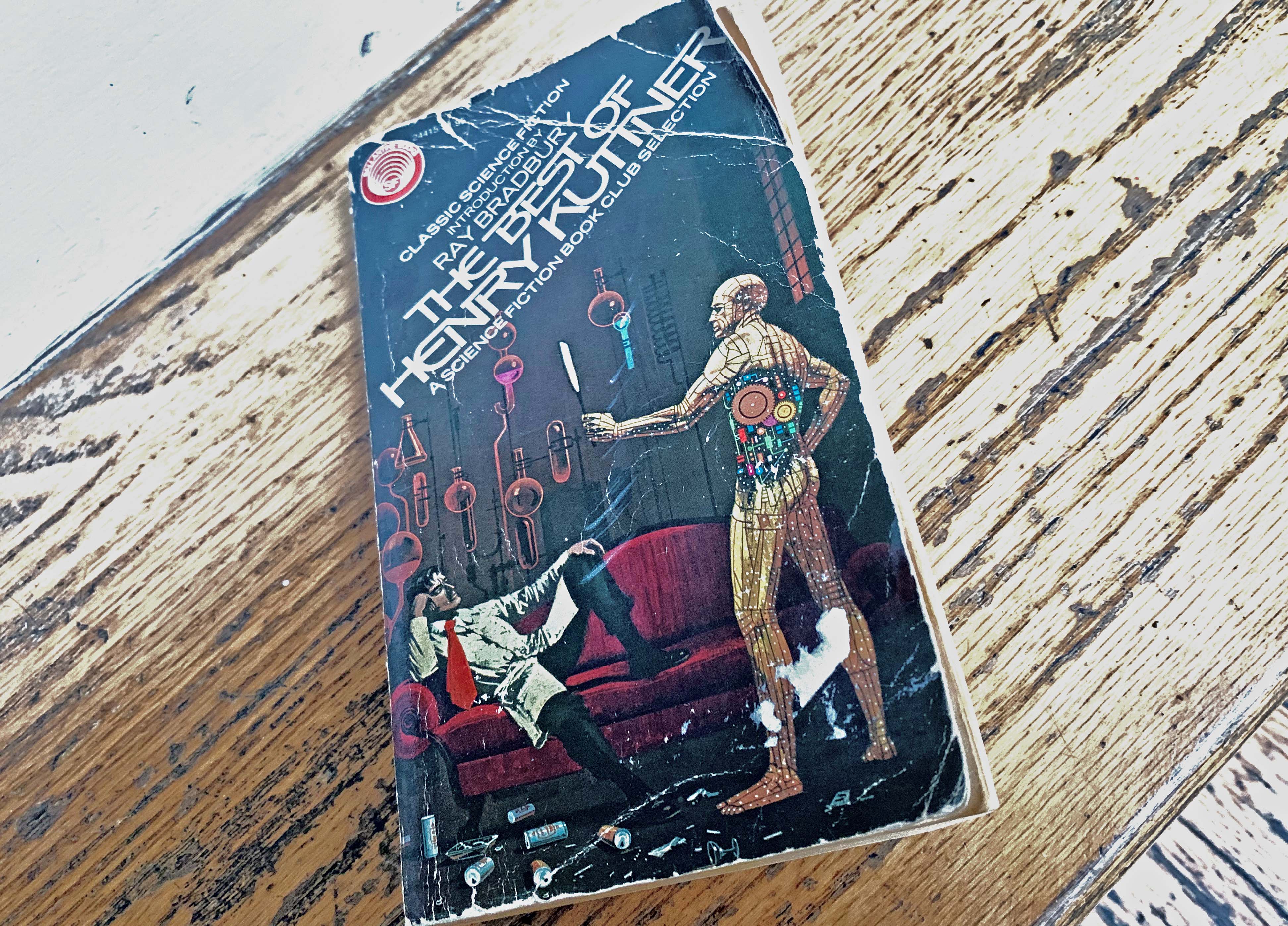
And I’m reading a paperback I found in a box on the street, printed in 1975, when I was twelve. My Dad owned it, so I read it, or most of it, when I was fifteen or sixteen. It’s the Best of Henry Kuttner, and I’ll talk more about it maybe in another post. The stories in it were written between 1941 and 1953, so this is a collection of twenty year old stuff my father had read in the SF magazines as a young man, who he bought again, as those magazines had been tossed by his mother. This collection itself, would be tossed by my mother, and I would find it again, on the side of the road, a year before my father died.

I stand now seventy years away from the earlier stories. I stand now forty five years away from the printing of the book. I stand now forty years from my first reading of it.

And after three weeks off facebook, I find, I can read an entire story without checking my device.

So I read The Twonky, a seminal story, a story that invents entire sub-genres all by itself, and found I had never read it before; I has mixed it up with The Little Black Bag, which is another story about another Twonky (which means an artifact from the future discovered in the past) by Kuttner.

I slip into Kuttner’s voice, his mind, effortlessly; decoding his time takes a bit of work, but as an SF reader that isn’t hard; it’s harder to understand the 40s and 50s than to absorb the SF elements, of course.

it’s good to read again.

I’m going to keep performing this brain surgery on myself. I miss my Facebook friends, but maybe I’ll figure out, how to have it all, someday. But I need to glue the shattered bits of my concentration together again. I have been poisoned by my feed; rage and friendship and humor, doled out like those little tickets that drive kids mad at Chuckee Cheese.

I wanna be someone who can read a book a night again.

And I want to write a few books a year.

For as long as I have left.

Gotta figure this out.


My Social Media Addiction

Reading Cal Newport’s Digital Minimalism at the moment.

It’s good. It puts meat on the bones of what we have all read in one form or another, or had friends tell us, about the problem of modernity; social media addiction, information overload, FOMO, fractured attention span. One has to wonder about the increased incidence of clinical mental illness in young people, too, as it relates to information technology. I should google that, someone must have figured out if there is a real correlation there.

I’m a few chapters in, abstaining from Facebook, my biggest problem, but of course, like all addicts, I find myself just shunting over to other similar addictive behaviors. Looking at my email every ten seconds. Checking my amazon KDP dashboard. Looking for any reviews of my current novella, which will be off the stands in a week or two.

I read too much News, staring at the same stuff over and over, zeroing in on stuff that outrages me, staring at COVID numbers.

I write this blog, and look for hits. I scan twitter, where I have no significant interactions with my content beyond a half dozen people I could email in a small list built in gmail if I wanted to really stay in touch.

What’s interesting is that the impulse dies pretty quick in these other spaces, they can’t really hold my attention, though they can fragment it.

I don’t get enough feedback, here, or in professional fiction writing, to be honest, or twitter, or email anymore, for the feedback loop of addiction to really catch and take hold.

My apple watch just told me to breathe. I did. This kind of interruption I’m told is healthy, as is the get up and walk around thing. I need to keep this and turn off other alerts. Fucking Hello Fresh is still bugging me somehow about signing up for the meal delivery service again. I know I turned that off.

But here’s the real problem.

The currency of social media, how you are paid, is in the interactions; comments, and likes, and shares, and hit numbers. It’s what writers used to call ‘ego-boo’ for ego boost, and it was widely understood among writers that this was a terrible thing, as you didn’t get paid for it, and even in the old days, it did nothing for your brand. It was, in short, writing for free for any reason, not doing your actual work.

Social media normalized writing for free for others. This had literally never existed before outside of letters to individuals, or to the editor. Writing is, or used to be, kinda hard, just getting the words grammatically and decent looking on paper; hand written in cursive or typed.

The killer quality of writing instead of calling people on the phone or talking in person is that it is asynchronous; I can write a FB post or a text and the person can respond whenever they feel like. So the communication feels less like an imposition.

What this really does is turn everyone into a very casual friend; the kind of friend who can ignore you and you can’t feel all that angry about it, as you behave in kind to others, now that it is normalized.

So the way that social media pays you, using the intermittent reward schedule that is addictive to every animal with a brain larger than a walnut, is approval, social interaction, but it replaces the deepest social interaction with a version of the same thing that is a much milder hit. So, of course, you need more. And, once used to more, you can’t be happy with less. At some point, social media will start to feel less dense, less meaningful, than IRL interaction, but we never really know the degree of other’s engagements. Who is hitting like out of habit, who just likes everything all the time to create engagement with their own content,

But again, I keep dodging around the point, which is, why is talking about something more important or funner than actually doing it?

Why aren’t you doing the thing you most want to be doing, in your own self assessment, in your own value system?

Are you lying to yourself about what you really want to do?

Going deeper, why do you care what other people think of you? People you barely know, I mean. Or even larger groups of people that aren’t your immediate family or coworkers?

Well, there is research that suggests that big networks of casual acquaintances works well for job hopping. Any everyone is always a heartbeat away from looking for a new job. So, there’s that. It’s a kind of prep work or hoarding.

But if it was a job search thing, really, you would do it an hour a day or something at most and be done with it. More of course when you are actually looking for work.

Remember when your teachers would say about you, on a report card, that so and so spends too much time socializing?

This before we had any kind of media at all, beyond phones that weighed as much as a quart of milk bolted to walls with corkscrew cords handcuffing us to them?

So, I think, for me, there’s a problem under the problem, which is why I can’t really fix the problem, as it lies deeper. And maybe it means there was something else I should do, or should have done, now that I’m too old to start a lot of stuff. Toiling away at Stand-up (probably to become one of those middle aged losers who have one act that they flog around and make barely enough to survive by leeching off others… hey I dream big.)

Working in a writing room, more collaboratively?

Being in some sort of field where I present a lot? Dear God, politics?

Because my brief experience with story telling, at the Moth, in person, was like taking crack. It let me focus in on that give and take between me and others like a goddamn laser with INSTANT split second feedback.

I was once a kind of lonely kid, reading books, and I became a very social kid, running around with a tribe of friends, splitting my time between them and my LTR girlfriends, reading books around the edges. Oh, and doing my work work, when I had to.

Anyway. I’m gonna do the Cal Newport one month fast and then try to add in the tech that aligns with my core values or whatever the fuck he’s going to tell me he does, because he’s better than me, but I’m guessing it won’t stick unless I fix what is wrong underneath, or stop defining that thing as wrong at all, and accepting it; to stop flogging myself for being a distracted creature that plods along at creative careers unable to ever get into, and stay in, the groove.

Because every groove feels like or a rut or a prison.

So, on that note, I’m gonna walk and listen to books. And switch them off and think. Intermittently. Fragmented.

That’s me. Now.

Does it have to be?

When The Suburbs Sang

My father played pool with two contractors named Joe, and Carlio. One was my father’s friend, or so he thought, and the other one, less so. So they built us a split level ranch in the suburbs of Syracuse New York in 1973 one summer, creating a clean break with our old elementary school, as we moved in before the new year began.

We moved less than two miles, from the city, to the suburbs, part of a vast white migration away from city centers into unsustainable suburbs. Nobody had run the numbers, or if they had, nobody cared, about the fact that as the infrastructure aged, in many suburbs, the taxes didn’t support fixing anything; the spread out houses, with the big lawns, with all that breathing room, were connected to grids that were stretched to the breaking point. Maintaining all the electrical and sewage stuff, fixing and plowing all those roads, for that population density, was kinda…

Stupid.

Oh, but the space a middle class person could afford. The distance from the neighbors. The two car garages, and the unfinished basements that could and often would be finished, the back yards into which decks could expand, into which swimming pools could be sunk.

No sidewalks for the kids to walk on, but who cared? Who needs parks with the swing set and sandbox in the back yard.

It seemed the most natural thing in the world.

My parents were academics, at that time one Ph.D, and one in the making. My mother from the deep south, with an accent that waned in the Northeast, and waxed on visits home, but was always there. My brother and I attended a city school, maybe 50% minority, which is and was something that is hard to sustain. The white people get scared and move out.

The school was I think, mediocre, in the way such things are typically measured. I scored very high on the Iowa exam, learned to read and do arithmetic by 4th grade, learned a bit of what we called social studies. I spent a lot of time in the library, looking at picture books of space travel by Willy Ley, whose paintings now looked kinda stupid as Apollo unfolded in the real world.

I was involved in a fight, in some way—we called it getting beat up, because me and my friends didn’t fight very well. Many of our classmates were much bigger than we were. My mother came in for a meeting with the VP in charge of discipline, (all schools have them. This way the principle can seem nicer.) and when she asked what was going to be done about the attack, the VP wanted to know what I had done to provoke it. What words I may have used.

She heard my mother’s southern accent loud and clear.

My parents decided to move that night.

About that word– my parents never used it, and my best friend taught me to never use it either, not even when we were alone, for reasons having less to do with social justice than survival. Or maybe my best friend had just figured out how horrible the word was. He was gay, I think, though I left town before that surfaces. Likewise my mother’s family, and her racist mother, never used that word, either. 

The word branded you as white trash. We weren’t necessarily enlightened. We were classist.

I can’t honestly remember being happy or sad about the move. It just was. But I loved watching the house be built that summer; pacing the foundation in the sea of mud. Walking into the basement from the backyard, as the property sloped downward and on that side, the basement had windows.

It would have been nice, if we had ever finished it. Or built a real deck onto the back of the house, where Joe and Carlio had hung a tiny balcony. But my parents salaries weren’t huge. Their retirement funds grew fantastically, but they weren’t allowed to ever touch them, which of course, is why my parents generation retired well, even the people in the middle class. So we never even poured a driveway over the gravel strip to the two car garage we started out with; which of course made plowing and shoveling the thing in the hideous Syracuse winters problematic.

My father hired a pickup with a plough, and it gouged up dirt and gravel.

My father hated any and all manual labor, so the large yard did nothing for my parents. My mother talked for seventeen years about putting in a garden, but only ever filled a little brick window box on the porch with petunias. They weren’t outdoor people. We never went camping. We never hiked. They never took us to parks. We never even got a swing set in that back yard, as we were ten and eleven and presumably needed to only wander the streets of the subdivision, or explore the vast tracks of undeveloped land surrounding us.

Which we did, and loved doing.

All this aside, I loved the suburbs, not knowing what I was missing, and for everything we missed, perhaps something was gained. Or did it it make into a person who enjoyed long lonely walks along mostly tamed wilderness? Who shrinks back from knowing the neighbors? We enjoyed the autonomy which would now be branded as neglect.

We never locked our doors. There was no mass transit. We rode bikes, but it was very hilly, glacially dumped Hobbiton mounds that were difficult to build on, and so, remained wild and lovely, poking up through the landscape sporting only the occasional pale blue water tower. Places for teens to drink and gaze out over a world of golf courses and ranch houses and drainage ditches, a vibrant but fading middle class, dying on the vine, like a cut flower, still colorful and bright as the manufacturing died and the big businesses all went bankrupt. The downtown that died, turning into a museum of a time gone by, shuttered by six o’clock every evening.

Except the University, Go Orange, which did just fine, becoming the cities biggest employer. My father had tenure. So we weren’t going anywhere, and we would never, ever want for anything, or even have the fear of wanting for anything.

Our only enemies lurked within. The restless madness of adolescence, the reason for armies and monasteries, the sequestering of violent young males. But there were no wars to send our testosterone poisoned, so instead, we went slowly mad in the weird toxic gasses given off by the cold war, the constant threat of annihilation, which troubled the thoughtful and which, like COVID today, was ignored by so many that the myth of the 80s now is one of patriotic exuberance, and not the punk counterculture gnawing at the tender trap of the fading post war dream.

Suburbia aged badly, like our Danish modern furniture, the nicks and scratches made it look like what it was; hastily constructed, a momentary fad, kinda cheap, and in the long run, not a good investment.

A shiny momentary dream of modernity to match the rockets racing to the moon, sputtering on the martini powered fumes of black and white JFK speeches, powered by Eisenhower’s prophesied monster, the military industrial complex. 

I am old enough to love my childhood uncritically, minimizing the paralyzing fear of the dark, my ostracization and the suicidal misery of middle-school, the homophobic bullying, the hatred of high-school, the absurd early morning bus rides to wait forty five minutes for homeroom.

Instead I remember the gleaming hardwood floors of the new house, the light coming through the windows, sledding on the golf course with my friends, who all lived with a ten minute walk, snow forts and spelunking in drainage tunnels, junkyards, quarries, hallucinogenic adolescent ecstasies,  vivid, violent, sexual awakening.

My first girlfriend, half nude in the steamed up car, her long, pale perfect body, the electricity of our touch. Orgasms like tactical nuclear explosions. 

The skunky sweetness of burning weed, the icy cold cheap American beer, the future an endless road to anywhere and nowhere. I tested well, in school, very, very high, so high my half assed grade hardly mattered. We had enough money. I could and would go anywhere and do anything.

I close my eyes and I’m listening to the weekend drone of lawn mowers, smelling freshly cut grass through my open bedroom window, prowling stacks of discarded periodicals for Playboy magazines, tucking centerfolds in my back pockets, organizing my comic books, penciling dungeons onto graph paper, mastering my first campaign.

We went to war with orcs in middle earth. We initiated ourselves and each other with powerful drugs in cemeteries and on golfing greens. We kissed in steamed up cars. Made out with strangers in finished basements.

We waited for the futures to unfold, ready to spring away from the joyful, perfect, soul numbing safety and isolation of our subdivisions. To leave suburbia behind, and in my case, never go back.

Which we never did. But some part of me lingers, never leaving, roaming that undeveloped land that is now packed with newer, even more souless McMansions. The past a different country, that boy a stranger I don’t really remember being.

Back when the suburbs seemed like a good idea.

Back when the suburbs sang.


Sue Grafton’s Interior Decoration

I have been amazed, over the years, at my love for Sue Grafton’s work, because so much of it consists of minutely observed details that have no bearing on plot whatsoever. Theme, tone, of course, is reflected in every part of the world, or rather the parts of it a POV or narrator chooses to call out, Grafton spends perhaps 10-20% of each of her books describing the interiors of spaces.

I’m one of those readers that let the specifics of a space wash over them, but tune into the details. I will not remember which wall the bookcase is shoved against, whether it’s opposite the king sized bed or the broken window, at all. There are readers that do, though.

But I do love me some details.

The interiors reflect the characters of the people that inhabit them; bring them into tighter focus.

The average private investigator in fiction will tell you the job is mostly boring details; Grafton makes you live every single one. The plot coupons, the stuff she uses to put her cases together, are completely invisible to me on every read. There’s so much detail to lose the important ones in. She has never once telegraphed an ending.

I have, at times, wondered how the hell she figured out what was going on; I have at times, been confused during the climax, because I have been mesmerized by all the ashtrays and tatty slip covers.

There’s a thing, where a writer describes some perfectly ordinary thing that you can’t recall anyone ever describing in prose before, and it makes you weirdly happy. I remember this during my first Salinger readings. I get that from Grafton a lot, in an among the turns of phrase we’ve all read ten thousand times.

Still, it’s an odd recommendation.

“Wanna read endless descriptions of rooms, houses, faces, lonely spaces, a made up stretch of coastline this detective runs every single goddamn morning?”

Turns out? You do.